
Roboidi – what’s new in the world of humanoid robots
Top story
Right now
The week in brief
The week in numbers
- News items: 2
- Company of the week: Fourier
- New robots in the catalogue: 42
Main stories
Meta builds humanoid robot with Chinese startup Fourier, The Information says
‘First’ insurance policy for domestic humanoid robots in the UK
Upcoming events
- 9. China International Import Expo (CIIE) (November 5 – 10, 2026, Shanghai, China, trade fair)
Na šanghajském veletrhu bude mít poprvé vlastní prostor Tesla, jejíž humanoidi mají předvádět tovární práce, nosit zavazadla i venčit psa.
- Conference on Robot Learning (CoRL 2026) (November 9 – 12, 2026, Austin, USA, conference)
Přední konference o strojovém učení robotů, kde se ukazuje výzkum, na kterém stojí ovládání humanoidů.
CoRL 2026 · according to the organiser - Ultimate Bots (UFB) Season 2 – TwitchCon San Diego (November 13 – 15, 2026, San Diego, USA, competition)
Úvodní zastávka druhé sezóny ligy zápasů humanoidních robotů UFB na festivalu TwitchCon.
Ultimate Bots – Schedule · according to the organiser
Trending this week
Fact
More facts and records →From history
252 years ago: Demonstration of the Jaquet-Droz automata
The Writer, the Draughtsman and the Musician automata were demonstrated in La Chaux-de-Fonds. The mechanical figures imitated writing, drawing and playing a keyboard instrument. (1774)
The full History of robots →Catalogue of humanoid robots
Facts and records → · You can compare robots using the “+ Compare” button.
NEO
1X Technologies · USA · since 2024
pilot deploymentNEO is a bipedal humanoid from 1X designed for the home. The series was publicly introduced with the NEO Beta prototype; the later home version also relies on remote assistance from an operator.
Price: from ≈ 436,000 CZK (pre-order)
In the History of robots: 2024 – The NEO Beta prototype · 2025 – The NEO humanoid goes on pre-sale for households · 2025 – Introduction of NEO Gamma
Sources: 1X – introduction of NEO Beta, 30. 8. 2024 · 1X – new headquarters in Palo Alto, 11. 7. 2025 · 1X – NEO Home Robot, pre-orders and how it is controlled · Wikipedia – 1X Technologies, headquarters and history of NEO
| height | 1,68 m (according to the manufacturer) [1] |
|---|---|
| weight | 30 kg (according to the manufacturer) [1] |
| payload | 25 kg (carrying) (according to the manufacturer) [1] |
| degrees of freedom | 75 (according to the manufacturer) [1] |
| battery life | 4 h (according to the manufacturer) [1] [2] [3] |
| speed | 1.4 m/s (walking), 6.2 m/s (running) (according to the manufacturer) [1] |
A3 Ultra
AgiBot (Zhiyuan Robotics) · China · since 2026
prototypeA full-bodied humanoid introduced at WAIC for services and communication with the public. It has an NVIDIA Thor computing platform and supports both charging and battery swapping.
| height | 1,74 m (according to the manufacturer) [1] |
|---|---|
| weight | 60 kg (according to the manufacturer) [1] |
| payload | 5 kg na jedno rameno (according to the manufacturer) [1] |
AgiBot A2 (Yuanzheng A2)
AgiBot (Zhiyuan Robotics) · China · since 2024
on saleA bipedal humanoid from the Shanghai company AgiBot, introduced in August 2024. The company mass-produces it at a factory in Shanghai, and in November 2025 it used it to set a Guinness record for walking over 100 km.
Price: from ≈ 649,000 CZK (manufacturer’s price list)
In the History of robots: 2025 – AgiBot A2 walked a record 106 kilometres
Sources: Wikipedie – AgiBot · Interesting Engineering – Agibot rivals Tesla’s Optimus with 5,000 humanoid robots in 2025 · China Daily – Optimized, primed: next-gen robots start rollout · AgiBot – A2 (official page)
| height | 1,69 m (according to the manufacturer) [1] |
|---|---|
| weight | 69 kg (according to the manufacturer) [1] |
| degrees of freedom | 40+ (according to the manufacturer) [1] |
| battery life | 2 h (according to the manufacturer) [1] |
G2 Max
AgiBot (Zhiyuan Robotics) · China · since 2026
prototypeA wheeled robot with a humanoid upper body, two force-controlled arms and an adjustable working height. It was introduced at WAIC for material handling and palletising.
X2 EDU
AgiBot (Zhiyuan Robotics) · China · since 2026
prototypeA modular educational variant of the X2 humanoid introduced at WAIC. Open interfaces and replaceable parts are intended to support teaching, competitions and robotics research.
| height | approximately 1.3 m (according to the manufacturer) [1] |
|---|---|
| degrees of freedom | 29 in the body (according to the manufacturer) [1] |
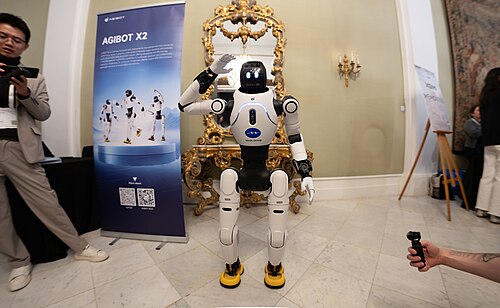
Lingxi X2 (AGIBOT X2)
AgiBot / Zhiyuan Robotics (AGIBOT Innovation (Shanghai) Technology Co., Ltd.) · China · since 2025
on saleA smaller bipedal humanoid about 1.3 m tall from the Shanghai company AgiBot, introduced in March 2025. It went on sale on 22/5/2025 in three versions and is aimed mainly at exhibitions, entertainment, education and guide services.
Price: from ≈ 508,000 CZK (manufacturer’s price list)
Sources: TechNode: AgiBot unveils Lingxi X2 (11. 3. 2025) · Yicai Global: China's AgiBot Launches New Humanoid Robot (22. 5. 2025) · AGIBOT: About / News – milestones (03/2025 X2 launched) · AGIBOT: X2 (official product page with specifications)
| height | approx. 1.31 m (according to the manufacturer) [1] |
|---|---|
| weight | approx. 35 kg (X2), approx. 39 kg (X2 Ultra) (according to the manufacturer) [1] |
| payload | max. 3 kg in certain positions, up to 1 kg across the entire workspace (according to the manufacturer) [1] |
| degrees of freedom | 25 (according to the manufacturer) [1] |
| battery life | approx. 2 h (walking at 0.5 m/s) (according to the manufacturer) [1] |
| speed | max. 1.8 m/s (normally up to 0.8 m/s) (according to the manufacturer) [1] |
Digit
Agility Robotics · USA · since 2019
on saleDigit is a bipedal robot with a torso and arms for handling objects. Agility deployed it commercially at GXO, where it moves totes in a warehouse.
Price: from ≈ 4,363,000 CZK (media estimate)
In the History of robots: 2019 – Introduction of the Digit robot · 2020 – Digit offered commercially · 2024 – Commercial agreement to deploy Digit
Digit 5
Agility Robotics · USA · since 2026
prototypeThe fifth generation of a bipedal industrial humanoid for warehouse handling. Development focuses on safe work near people and interchangeable grippers. In September 2026, the robot was still under development.
Sources: Agility Robotics – Digit 5 · Manufacturing Dive – introduction and development status of Digit 5
| payload | 23 kg (declared value under development) (according to the manufacturer) [1] |
|---|
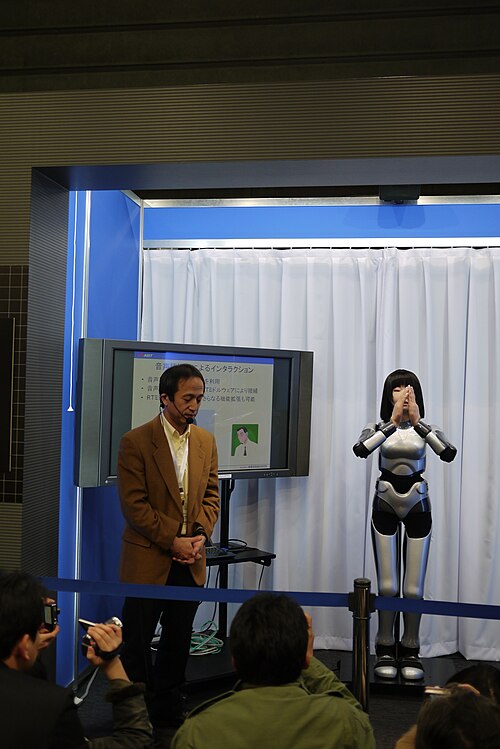
HRP-4C
AIST · Japan · since 2009
prototypeHRP-4C is an AIST humanoid with a human-looking head and hands. The research platform demonstrated walking, dancing and singing using voice synthesis.
In the History of robots: 2009 – Introduction of the HRP-4C humanoid
HRP-5P
AIST · Japan · since 2018
prototypeHRP-5P is an AIST research humanoid for handling heavy materials. In a demonstration on a simulated construction site, it carried and fastened plasterboard panels on its own.
Sources: AIST – HRP-5P and the history of the HRP series, 2018 · IEEE Spectrum – introduction of Japan's HRP-5P, September 2018 · AIST–CNRS JRL – research robot platforms
| height | 1,82 m (according to the manufacturer) [1] |
|---|---|
| weight | 101 kg (according to the manufacturer) [1] |
| degrees of freedom | 37 (according to the manufacturer) [1] |
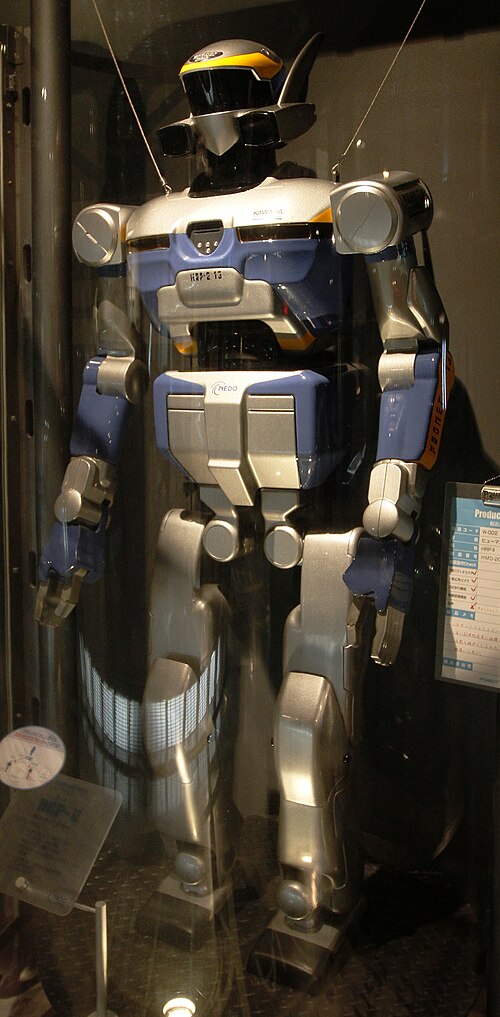
HRP-2
AIST / Kawada Industries · Japan · since 2002
prototypeHRP-2 is a research humanoid developed jointly by AIST and Kawada Industries. It can walk on two legs and get up from the ground after a fall.
In the History of robots: 2003 – HRP-2 as a research platform
Sources: IEEE Robots Guide – HRP-2 · AIST – announcement of HRP-5P and the history of the series, 27. 9. 2018 · Kawada Robotics – research platforms HRP-2, HRP-3 and HRP-4
| height | 1,54 m [1] [2] |
|---|---|
| weight | 58 kg [1] [2] |
| degrees of freedom | 30 [1] [2] |
HRP-4
AIST / Kawada Industries · Japan · since 2010
prototypeHRP-4 is a bipedal research platform from Kawada Industries and AIST. It was created for research into robots working in environments shared with people and into handling objects.
Sources: IEEE Robots Guide – HRP-4 · AIST – Development of HRP-4, 2010 · Kawada Robotics – research platforms HRP-2, HRP-3 and HRP-4
| height | 1,51 m [1] [2] |
|---|---|
| weight | 39 kg [1] [2] |
| degrees of freedom | 34 [1] [2] |
Apollo
Apptronik · USA · since 2023
pilot deploymentApollo is a humanoid from Apptronik designed mainly for handling tasks in logistics and manufacturing. Mercedes-Benz is testing its use in supplying production.
Sources: Apptronik – introduction of Apollo, 23. 8. 2023 · Axios – Apollo a Apptronik v Austinu, 4. 9. 2023 · Apptronik – pilot Apollo u Mercedes-Benz, 15. 3. 2024 · Le Monde – testing of Apollo at Mercedes-Benz, 15. 3. 2025 · Apptronik – overview of announcements, including development and testing in 2026
| battery life | 4 h [1] [2] |
|---|
Apollo 2
Apptronik · USA · since 2026
prototypeA humanoid platform in both bipedal and wheeled configurations collects data for robot learning. At its introduction, Apptronik described fleet operations at Robot Park training centres and at customers' and partners' sites.
Astribot S1
Astribot (Stardust Intelligence) · China · since 2024
prototypeA humanoid robotic assistant on a wheeled base from the Shenzhen company Astribot, a subsidiary of Stardust Intelligence. In April 2024 it demonstrated very fast and precise household tasks on video.
| height | 1,70 m (according to the manufacturer) [1] |
|---|---|
| weight | 80 kg (according to the manufacturer) [1] |
| degrees of freedom | 7 per arm (according to the manufacturer) [1] |
| speed | 10 m/s (arm tip) [1] [2] |
| payload | 5 kg per arm (according to the manufacturer) [1] |
Tiangong
Beijing Humanoid Robot Innovation Center · China · since 2024
prototypeAn open platform for a full-size humanoid that the Beijing innovation centre introduced in April 2024 as the first electrically powered humanoid capable of running. The newer Tiangong Ultra version won the first humanoid robot half marathon in Beijing in April 2025.
Sources: Beijing Humanoid Robot Innovation Center – press release · CGTN · Beijing Municipal Government (english.beijing.gov.cn)
| height | 1,63 m [1] [2] |
|---|---|
| weight | 43 kg [1] [2] |
| speed | 6 km/h [1] [2] |
Booster T1
Booster Robotics · China · since 2024
on saleA smaller humanoid from the Beijing company Booster Robotics for developers, research and teaching, introduced at the World Robot Conference in August 2024. Teams using it won the AdultSize category at RoboCup 2025 and 2026.
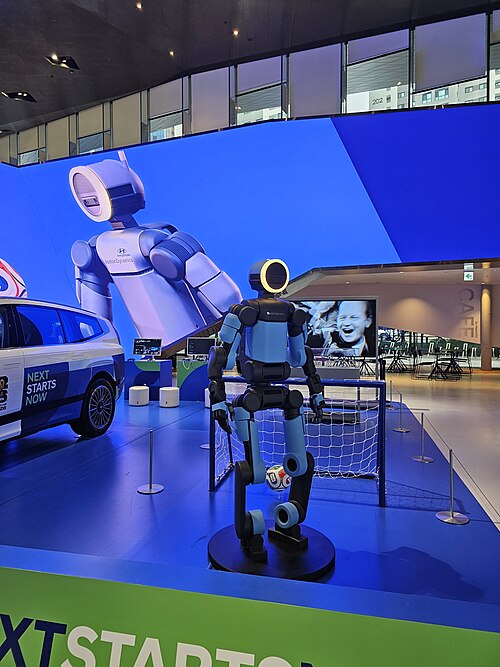
Atlas (elektrický)
Boston Dynamics · USA · since 2024
pilot deploymentThe electric Atlas is a Boston Dynamics humanoid being developed for industrial tasks. In 2026, a test site for its training was set up at Hyundai.
In the History of robots: 2024 – Atlas switches to electric drive · 2026 – Atlas hands over the ball at the football World Cup · 2026 – Opening of the Atlas training centre at Hyundai · 2026 – The production Atlas and the start of manufacturing
Sources: Boston Dynamics – the electric Atlas and the end of the hydraulic line, 2024 · IEEE Robots Guide – the electric Atlas and the history of its generations · Boston Dynamics – production version of Atlas and deployment in 2026 · Axios – Atlas test centre at Hyundai, 21. 9. 2026
| height | 1,9 m (according to the manufacturer) [1] |
|---|---|
| weight | 90 kg (according to the manufacturer) [1] |
| payload | 30 kg continuously, 50 kg briefly, 20 kg with one hand (according to the manufacturer) [1] |
| degrees of freedom | 56 (according to the manufacturer) [1] |
| battery life | 4 h (2 h during heavy lifting) (according to the manufacturer) [1] |
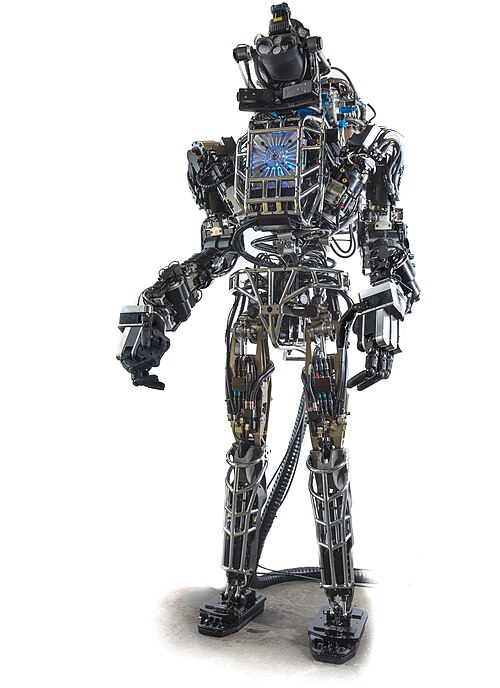
Atlas (hydraulický)
Boston Dynamics · USA · since 2013
discontinuedThe hydraulic Atlas was created at Boston Dynamics as a humanoid platform for the DARPA Robotics Challenge. The hydraulic development line was later replaced by the electric Atlas.
In the History of robots: 2013 – Atlas for the DARPA challenge · 2017 – Atlas performs a backflip
Protoclone V1
Clone Robotics · Poland · since 2025
prototypeA biomimetic android with a polymer skeleton mimicking 206 human bones and more than a thousand artificial Myofiber muscles. In a demo from February 2025 it hung in a frame; it cannot walk yet.
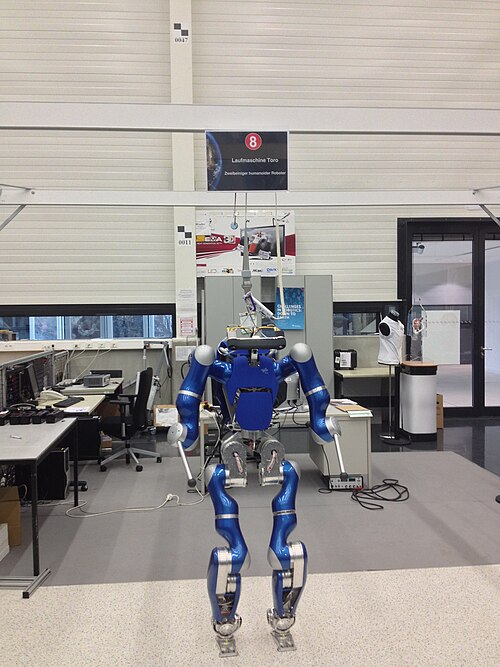
TORO
DLR · Germany · since 2013
prototypeTORO is a humanoid from DLR, the German Aerospace Center. It is used for research into bipedal walking, balance and the coordination of movement with manipulation.
| height | 1,74 m [1] [2] |
|---|---|
| weight | 76 kg [1] [2] |
| payload | 10 kg [1] [2] |
EngineAI PM01
EngineAI (Shenzhen EngineAI Robotics Technology) · China · since 2024
on saleA smaller humanoid from the Shenzhen company EngineAI, introduced in December 2024 for commercial and educational use. In February 2025, the company released a video showing PM01 doing a front flip.
Price: from ≈ 289,000 CZK (manufacturer’s price list)
Sources: The Robot Report – EngineAI releases PM01 humanoid robot for commercial, educational use · Wikipedie – EngineAI
| height | 1,38 m [1] [2] |
|---|
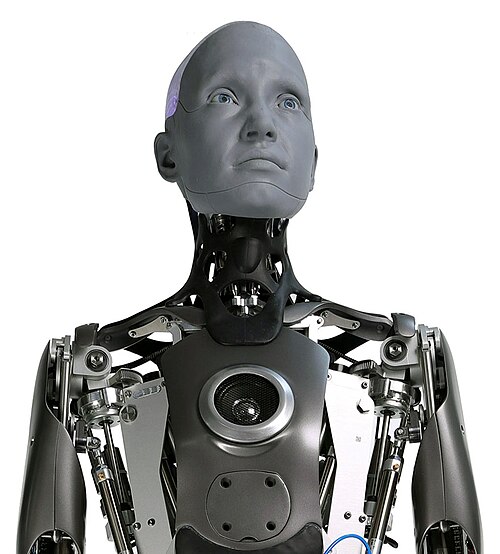
Ameca
Engineered Arts · United Kingdom · since 2021
on saleAmeca is a humanoid from Engineered Arts designed for communicating with people. It moves its arms, hands and face; its full-body version has two legs, but it does not walk on its own.
Price: from ≈ 5,454,000 CZK (media estimate)
In the History of robots: 2021 – The Ameca humanoid
Sources: Engineered Arts – Ameca, offer and specifications · Engineered Arts – Ameca, specifikace generace 2.6 · Engineered Arts – history and headquarters in Falmouth · Heinz Nixdorf MuseumsForum – Ameca v muzeu, 25. 7. 2025
| height | 1,87 m [1] [2] |
|---|---|
| weight | 62 kg [1] [2] |
| degrees of freedom | 61 (according to the manufacturer) [1] |
Figure 01
Figure AI · USA · since 2023
discontinuedThe first humanoid robot from the American company Figure AI, introduced in March 2023, at first only in renders, and in autumn 2023 in its first public walk. It was never sold; in August 2024 it was replaced by the second generation, Figure 02, and later by Figure 03.
In the History of robots: 2023 – Figure 01's first steps
Sources: Figure AI (PR Newswire): Figure emerges from stealth and unveils Figure 01 (2. 3. 2023) · IEEE Spectrum: Figure Promises First General-Purpose Humanoid Robot (2. 3. 2023) · The Robot Report: Figure 01 humanoid takes first public steps · Figure AI (PR Newswire): Figure unveils Figure 02, its second-generation humanoid (6. 8. 2024) · Wikipedie: Figure AI
| height | 1,68 m (5 ft 6 in) [1] [2] |
|---|---|
| weight | 60 kg [1] [2] [3] |
| payload | 20 kg [1] [2] [3] |
| battery life | 5 h [1] [2] |
Figure 02
Figure AI · USA · since 2024
discontinuedThe second generation of Figure AI's humanoid, introduced in August 2024. It worked for eleven months at the BMW plant in Spartanburg, and in November 2025 the company began retiring it in favour of the Figure 03 model.
In the History of robots: 2024 – Introduction of Figure 02 · 2025 – Figure 02 ends its 11-month deployment at BMW
Sources: PR Newswire – Figure unveils Figure 02 (Figure press release) · Robotics 24/7 – Figure AI unveils second-generation humanoid robot Figure 02 · Figure – F.02 Contributed to the Production of 30,000 Cars at BMW · Interesting Engineering – Figure humanoid robots retire after 11 months at BMW
| height | 1,68 m (5 ft 6 in) [1] [2] |
|---|---|
| weight | 70 kg [1] [2] |
| payload | 20 kg [1] [2] |
| battery life | 5 h [1] [2] |
| speed | 1,2 m/s [1] [2] |
Figure 03
Figure AI · USA · since 2025
pilot deploymentThe third generation of Figure AI's humanoid, introduced on 9 October 2025 and designed for the Helix AI model, for the home and for mass production at the BotQ plant. By April 2026, the company had built over 350 units for its own development, data collection and development of commercial use.
In the History of robots: 2026 – Figure 03 demonstrates logistics work at BMW
Sources: Figure – Introducing Figure 03 · ITmedia AI+ – Figure 03 · Figure – Ramping Figure 03 Production
| payload | 20 kg [1] [2] |
|---|---|
| battery life | 5 h [1] [2] |
| height | 5 ft 8 in (approx. 1.73 m) (according to the manufacturer) [1] |
| weight | 61 kg (according to the manufacturer) [1] |
| speed | 1,2 m/s (according to the manufacturer) [1] |
Phantom MK-1
Foundation Future Industries · USA · since 2025
pilot deploymentA humanoid from the San Francisco startup Foundation (founded 2024) intended for industry and the military. It is being tested in factories and docks, and in 2026 the company sent two units to Ukraine for reconnaissance support.
Sources: Foundation – Phantom · NBC Bay Area · CNBC · TIME · SFGATE – first public demonstration of Phantom, 5/2/2025 · Wikipedia – Foundation, Inc., Phantom MK-1
| height | 1,8 m [1] [2] |
|---|---|
| weight | 80 kg (according to the manufacturer) [1] |
| payload | 40 kg (according to the manufacturer) [1] |
| degrees of freedom | 29 (according to the manufacturer) [1] |
| speed | 1,7 m/s (according to the manufacturer) [1] |
Fourier GR-2
Fourier · China · since 2024
prototypeThe second generation of the GR humanoid from the Shanghai company Fourier, introduced at the end of September 2024. Compared with GR-1, it is taller and has a removable battery and hands with 12 degrees of freedom.
Sources: Fourier / PR Newswire – Fourier Unveils the Next-Generation Humanoid Robot GR-2 · The Robot Report – Fourier launches GR-2 humanoid, software platform · Engineering.com – Fourier Unveils Next-Generation Humanoid Robot GR-2 · Wikipedie – Fourier (company)
| height | 1,75 m [1] [2] |
|---|---|
| weight | 63 kg [1] [2] |
| degrees of freedom | 53 [1] [2] |
| payload | 3 kg (one arm) [1] [2] |
| battery life | up to 2 h [1] [2] |
Fourier GR-3
Fourier · China · since 2025
prototypeA humanoid from Fourier introduced in August 2025 as a “Care-bot” for companionship and care. It has a soft covering and an interaction system combining sight, hearing and touch; the company plans to deploy it in care homes for the elderly and in rehabilitation centres.
Sources: Fourier / PR Newswire – Meet GR-3: Beyond Function, Designed to Care · TechNode – Fourier Intelligence unveils the „Care-bot“ GR-3
| height | 1,65 m [1] [2] |
|---|---|
| weight | 71 kg [1] [2] |
| payload | approx. 3 kg (one arm) (according to the manufacturer) [1] |
| degrees of freedom | 55 [1] [2] |
| battery life | approx. 3 h (according to the manufacturer) [1] |
| speed | 6,1 km/h (according to the manufacturer) [1] |
N1 (Nexus-01)
Fourier · China · since 2025
prototypeAn open bipedal research platform introduced in April 2025. The manufacturer's documentation describes whole-body control, walking, running and stair traversal. N1 has its own design and documentation alongside the GR series.
Sources: Fourier – dokumentace Nexus-01 · Global Times – history of Fourier and introduction of N1 in April 2025
| degrees of freedom | 23 (according to the manufacturer) [1] |
|---|
GR-1
Fourier Intelligence · China · since 2023
on saleThe first general-purpose humanoid from the Shanghai company Fourier Intelligence, known for its rehabilitation robots and exoskeletons. It was introduced in July 2023 at the World AI Conference in Shanghai, and at the end of 2023 the company announced a production version.
Price: from ≈ 4,363,000 CZK (manufacturer’s price list)
Sources: Yicai Global – Fourier Intelligence Debuts General-Purpose Humanoid Robot · IEEE Spectrum – Video Friday: Fourier Intelligence · The Robot Report – Fourier Intelligence launches production version of GR-1
| height | 1,65 m [1] [2] [3] |
|---|---|
| weight | 55 kg [1] [2] [3] |
| degrees of freedom | 40 [1] [2] [3] |
| speed | 5 km/h [1] [2] [3] |
| payload | 50 kg [1] [2] [3] |
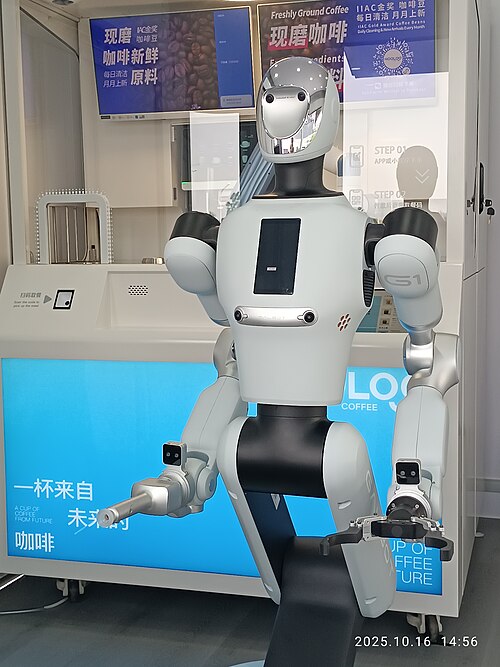
Galbot G1
Galbot (Galaxy General Robot) · China
on saleA wheeled upper-body humanoid with two arms from the Beijing company Galbot for shops, warehouses and pharmacies. In March 2026 it began serving at a pharmacy in Beijing, and in March 2026 the company raised 2.5 billion yuan.
AEON
Hexagon Robotics · Switzerland · since 2025
pilot deploymentAn industrial humanoid with wheeled locomotion and interchangeable tools for handling, part inspection and environment sensing. At BMW's Leipzig plant, it performs production tasks while also being trained for further applications.
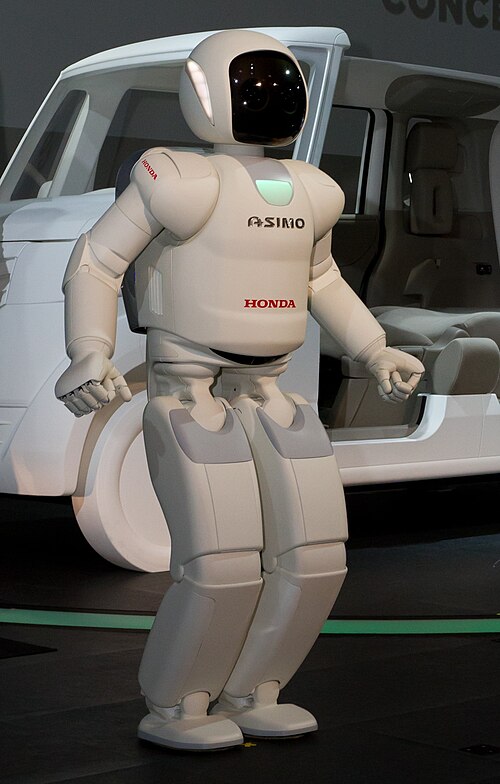
ASIMO
Honda · Japan · since 2000
discontinuedHonda's bipedal humanoid, introduced in 2000 as the culmination of the E and P series and gradually improved up to the 2011 version. Its public appearances ended on 31 March 2022.
In the History of robots: 2000 – Honda presents ASIMO · 2005 – New ASIMO works with people · 2011 – New ASIMO with autonomous behaviour
Sources: Honda – History of robotics development · Miraikan – About the End of Demonstrations by Humanoid Robot ASIMO · SoraNews24 – ASIMO retires from performing after 22 years
| speed | 6 km/h (running, 2005 version) (according to the manufacturer) [1] |
|---|
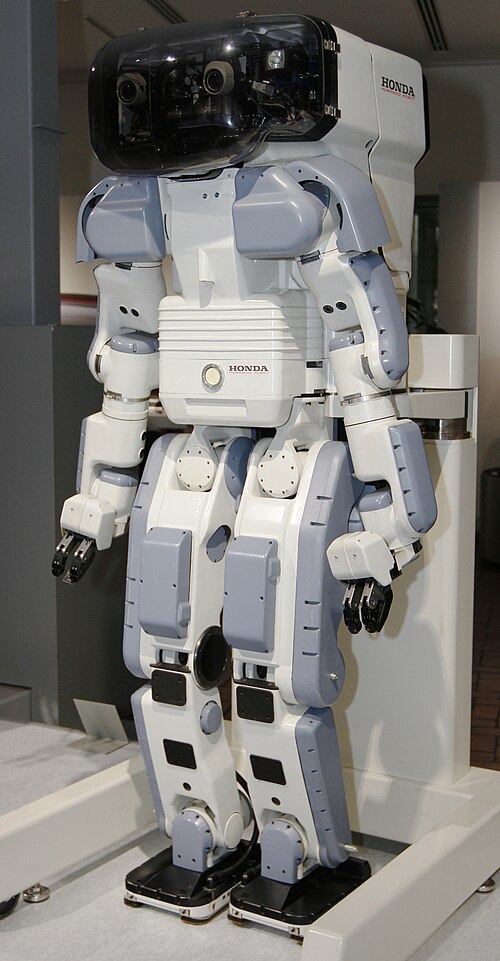
P2
Honda · Japan · since 1996
discontinuedHonda's humanoid prototype introduced in December 1996, the first bipedal walking humanoid with a computer, battery and wireless control inside its torso. In 2026, IEEE recognised it as an IEEE Milestone, and it is on display at the Honda Collection Hall.
In the History of robots: 1996 – Introduction of the Honda P2
Sources: Honda – History of robotics development · IEEE Spectrum – 30 Years Ago, Robots Learned to Walk Without Falling · Honda – Honda’s P2 Humanoid Robot (IEEE Milestone)
| weight | 210 kg [1] [2] |
|---|---|
| height | 1,82 m (according to the manufacturer) [1] |
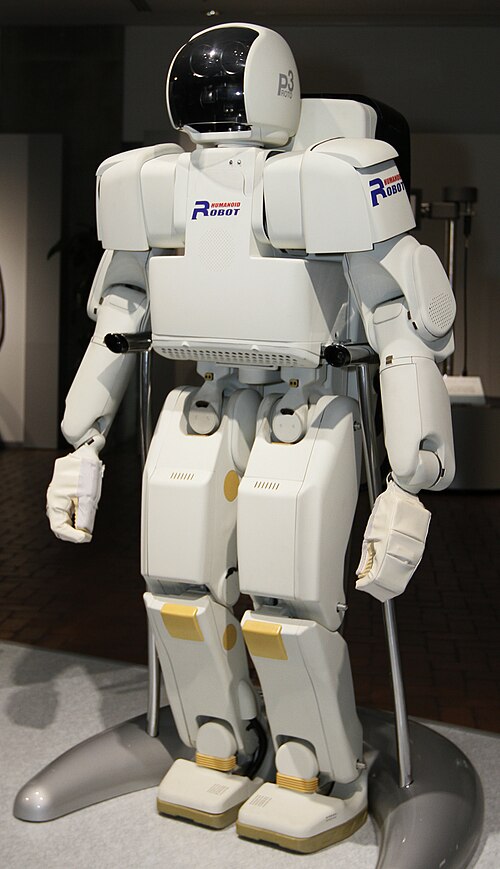
P3
Honda · Japan · since 1997
discontinuedA smaller and lighter successor to P2, completed in September 1997 as a fully independent bipedal humanoid. Thanks to different materials and distributed control, it came close to a size suitable for human environments and led to the ASIMO robot.
In the History of robots: 1997 – Completion of the Honda P3
| height | 1,6 m (according to the manufacturer) [1] |
|---|---|
| weight | 130 kg (according to the manufacturer) [1] |
HMND 01 Alpha
Humanoid (SKL Robotics Ltd.) · United Kingdom · since 2025
pilot deploymentA wheeled humanoid with two arms from the London company Humanoid, introduced in September 2025 and developed in seven months. It is used for tests in warehouses, logistics and shops; the company offers it on a robot-as-a-service basis.
Sources: Humanoid – Humanoid Unveils the UK’s First Humanoid Robot For Industrial Use · The Robot Report – U.K.-based startup Humanoid unveils HMND 01 Alpha mobile manipulator · Siemens – test HMND 01 Alpha v Erlangenu, 16. 4. 2026 · Heise – Siemens tests autonomous humanoid AI robot, 21. 4. 2026
| height | 2,20 m [1] [2] |
|---|---|
| payload | 15 kg (with both arms) [1] [2] |
| degrees of freedom | 29 (excluding end effectors) [1] [2] |
| speed | 7,2 km/h [1] [2] |
Iggy Rob Home
igus · Germany · since 2026
on saleA service variant of the wheeled humanoid Iggy Rob for reception, teaching and transporting objects. It has two arms, a display for simple facial expressions and a linear axis that extends its working reach.
Sources: igus – introduction of Iggy Rob Home, 3/6/2026 · Betriebstechnik & Instandhaltung – Iggy Rob Home
| price | from 55 000 EUR (June 2026 announcement) (according to the manufacturer) [1] |
|---|---|
| payload | 2.5 kg per ReBeL arm in the basic configuration (according to the manufacturer) [1] |
Iggy Rob Industrial
igus · Germany · since 2025
on saleA wheeled humanoid with two robotic arms for manufacturing and logistics. Originally introduced as Iggy Rob, the manufacturer later uses the designation Industrial. Customers are offered an application trial before purchase.
Sources: igus – introduction of Iggy Rob, 7/5/2025 · Robotics & Automation News – Iggy Rob na automatica 2025 · igus – distinction between Industrial and Home, 3/6/2026
| height | approximately 1.70 m (version introduced in 2025) (according to the manufacturer) [1] |
|---|
ergoCub
Istituto Italiano di Tecnologia · Italy · since 2023
prototypeAn IIT research humanoid derived from the iCub platform, designed with ergonomics in mind to help reduce the physical strain on workers in industry and hospitals. It was introduced on 21 September 2023 in Genoa at IIT's 20th anniversary.
Sources: IIT OpenTalk – A new robot for the first 20 years of IIT · ANSA – IIT celebrates 20th anniversary with worker-friendly robot
| height | 1,5 m [1] [2] |
|---|---|
| weight | 55,7 kg [1] [2] |
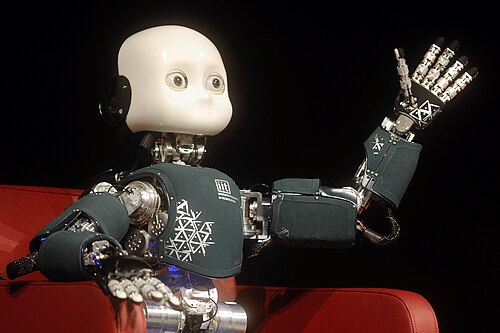
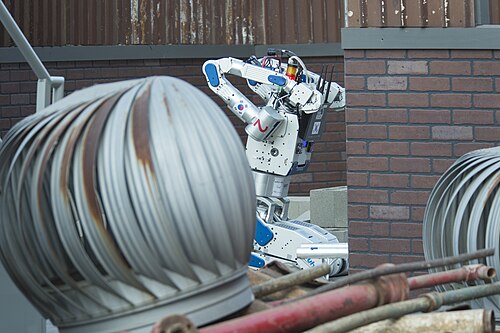
iCub
Istituto Italiano di Tecnologia · Italy
on saleAn open-source research humanoid the size of a small child, developed since 2004 in the European RobotCub project and later at IIT for research into embodied artificial intelligence. Laboratories can obtain it from IIT for a fee.
Price: from ≈ 4,872,000 CZK (manufacturer’s price list)
In the History of robots: 2008 – First version of the open iCub platform
Sources: IIT – iCub History · IIT – iCub Product catalog · Metta a kol. – The iCub humanoid robot (PerMIS'08)
| degrees of freedom | 53 [1] [2] |
|---|---|
| price | approx. 250,000 EUR (indicative, 2026) (according to the manufacturer) [1] |
DRC-HUBO
KAIST · South Korea · since 2013
prototypeA humanoid from the KAIST team and its spin-off Rainbow, which can switch from walking to rolling on wheels in its knees. In June 2015 it won the DARPA Robotics Challenge finals and, with them, a prize of 2 million USD.
In the History of robots: 2015 – DRC-Hubo wins the DARPA challenge
Forerunner K2 „Bumblebee“
Kepler Robotics (Shanghai Kepler Robotics Co., Ltd.) · China · since 2024
on saleAn industrial humanoid from the Shanghai company Kepler, introduced in October 2024 as the fifth generation of its robots. Pre-sales began at WAIC 2025 and mass production in September 2025; the company reports deliveries to customers and tests in factories and logistics.
Price: from ≈ 813,000 CZK (media estimate)
Sources: Interesting Engineering: China's new humanoid robot boasts 52 degrees of freedom, 8-hour stamina (21. 10. 2024) · Kepler (PR Newswire): K2 "Bumblebee" moves into mass production (26. 9. 2025) · Kepler (PR Newswire): Forerunner K2 completes 8-hour livestream at WAIC 2025, pre-sales · Jiemian Global: China's humanoid robot start-ups race to scale before Tesla arrives · Kepler: Forerunner K2 (official product page)
| height | 1,75 m [1] [2] [3] |
|---|---|
| weight | 75 kg [1] [2] |
| payload | 30 kg (both arms), 15 kg one arm [1] [2] [3] |
| degrees of freedom | 52 (development version; basic version 30) [1] [2] [3] |
| battery life | 8 h [1] [2] |
| price | from 248,000 CNY (2025, basic configuration) (according to the manufacturer) [1] |
Kuavo
Leju Robotics · China
on saleA full-size bipedal humanoid from Leju of Shenzhen, linked to Huawei's Pangu model. According to the IPO prospectus, the company sold 577 Kuavo units in 2025, compared with 32 in 2024.
| height | 1,66 m (according to the manufacturer) [1] |
|---|---|
| weight | 55 kg (according to the manufacturer) [1] |
| degrees of freedom | 22 (without end effectors) (according to the manufacturer) [1] |
| battery life | 1 h walking (according to the manufacturer) [1] |
| speed | 5 km/h (running) (according to the manufacturer) [1] |
LimX Oli
LimX Dynamics · China · since 2025
on saleA full-size humanoid for embodied AI research, launched on 30. 7. 2025 in Lite, EDU and Super versions. At first it was sold only in mainland China.
| height | 1,65 m [1] [2] |
|---|---|
| degrees of freedom | 31 [1] [2] |
| weight | up to 55 kg (with battery) (according to the manufacturer) [1] |
| battery life | approx. 1.5 h (according to the manufacturer) [1] |
| speed | 5 km/h (according to the manufacturer) [1] |
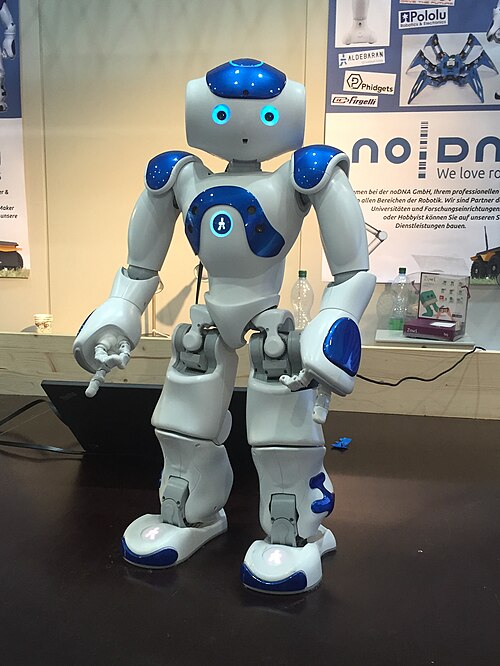
NAO
Maxtronics (Maxvision Technology) · France
on saleA small programmable humanoid originally from the Paris company Aldebaran, used mainly in education and research. After Aldebaran's liquidation, its assets were bought in July 2025 by China's Maxvision Technology, and NAO6 is now sold by its French subsidiary Maxtronics.
Price: from ≈ 203,000 CZK (seller’s price)
In the History of robots: 2008 – NAO in the RoboCup Standard Platform League
Sources: Maxtronics – Company · The Robot Report – Maxvision buys core robot assets of Aldebaran · Maxtronics – NAO6
| height | 58 cm (according to the manufacturer) [1] |
|---|---|
| degrees of freedom | 25 (according to the manufacturer) [1] |
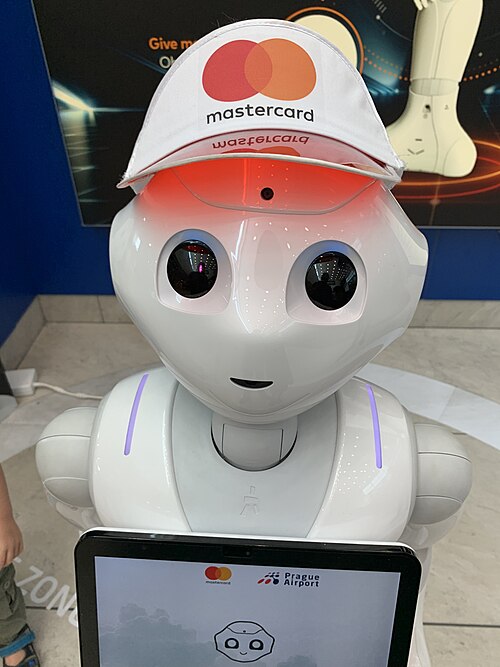
Pepper
Maxvision Technology (aktiva Aldebaran) · China · since 2014
discontinuedA semi-humanoid on a wheeled base with a touch display on its chest, designed for communicating with people and recognising emotions. Production stopped in 2020–2021, and in 2025 the Chinese company Maxvision bought the rights and assets of the bankrupt Aldebaran.
In the History of robots: 2014 – Introduction of the Pepper robot · 2015 – Pepper goes on sale
Sources: Wikipedie – Pepper (robot) · heise online – Pepper and Nao rescued: Maxvision buys insolvent robotics company Aldebaran
| height | 1,21 m (according to the manufacturer) [1] |
|---|---|
| weight | 29 kg (according to the manufacturer) [1] |
MenteeBot
Mentee Robotics (od 2026 součást Mobileye, „Mentee by Mobileye“) · Israel · since 2024
prototypeA humanoid from the Israeli company Mentee Robotics, which came out of stealth in April 2024 and is intended for warehouses, manufacturing and later households. The company was bought by Mobileye in 2026; pilot tests with customers are planned for 2026, and production of the first series not until 2027.
Sources: Mentee Robotics (Business Wire): Mentee Robotics Unveils MenteeBot (17. 4. 2024) · Globes: Amnon Shashua unveils MenteeBot humanoid robot · Interesting Engineering: Israel unveils house chore humanoid robot (23. 4. 2024) · The Robot Report: Mobileye to acquire Mentee Robotics for $900M (7. 1. 2026) · MenteeBot: AI First (official website, “Mentee by Mobileye”)
| height | 1,75 m [1] [2] |
|---|---|
| weight | 70 kg [1] [2] |
| payload | 25 kg [1] [2] [3] |
| speed | 1,5 m/s [1] [2] |
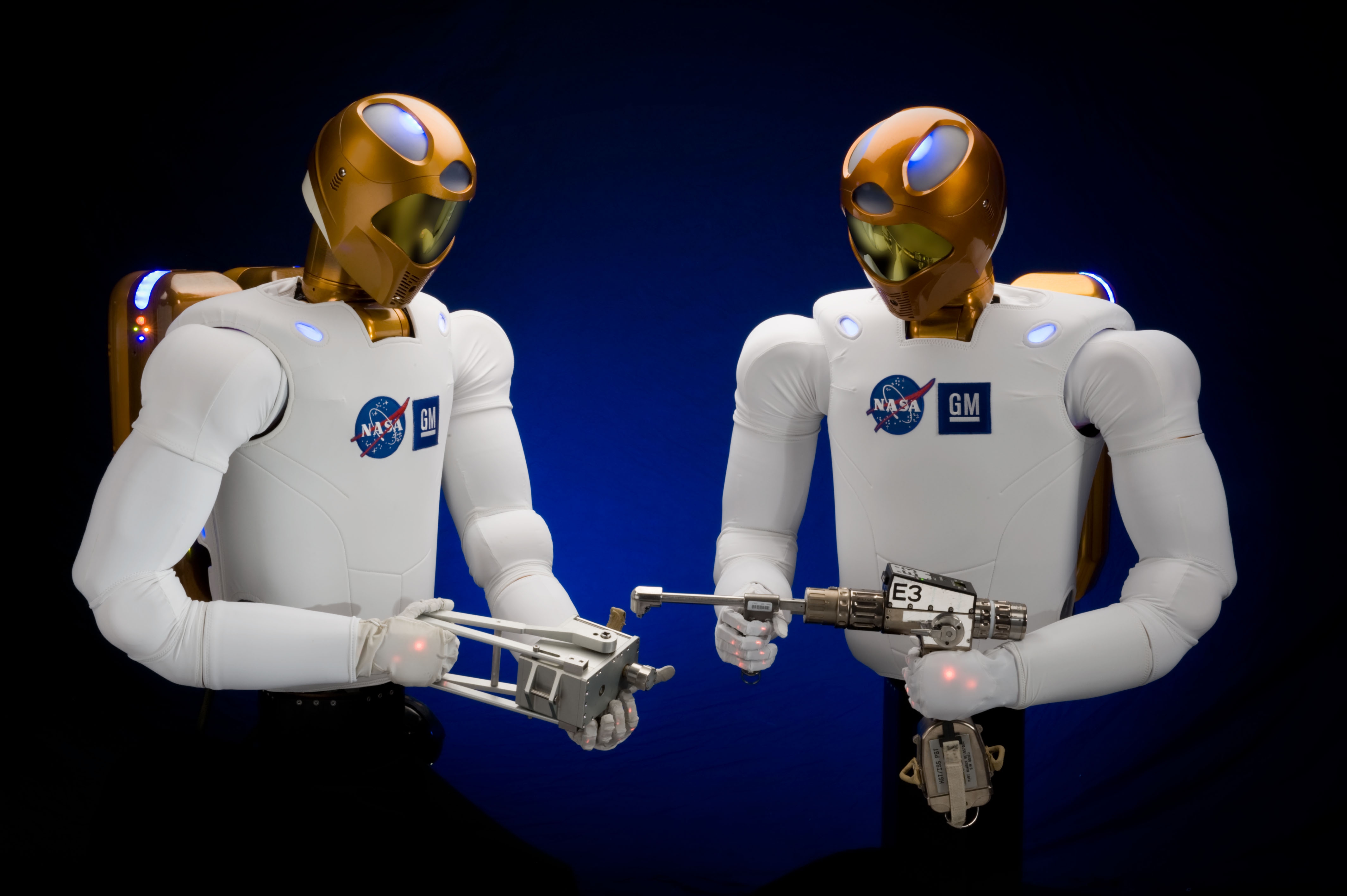
Robonaut 2
NASA · USA · since 2010
discontinuedA dexterous humanoid developed by NASA together with General Motors, which in 2011 became the first humanoid robot in space. It worked on the ISS until 2018, when it returned to Earth because of malfunctions, and it is now on display at the Udvar-Hazy Center.
In the History of robots: 2010 – Introduction of Robonaut 2 · 2011 – Robonaut 2 flies to space
Sources: NASA – NASA to Launch Human-Like Robot to Join Space Station Crew (2010) · NASA – Robonaut 2 · National Air and Space Museum – A Robot Could Be an Astronaut's Best Friend · collectSPACE – Robonaut-2 reunited with its ride into space at Smithsonian
| degrees of freedom | 42 (according to the manufacturer) [1] |
|---|
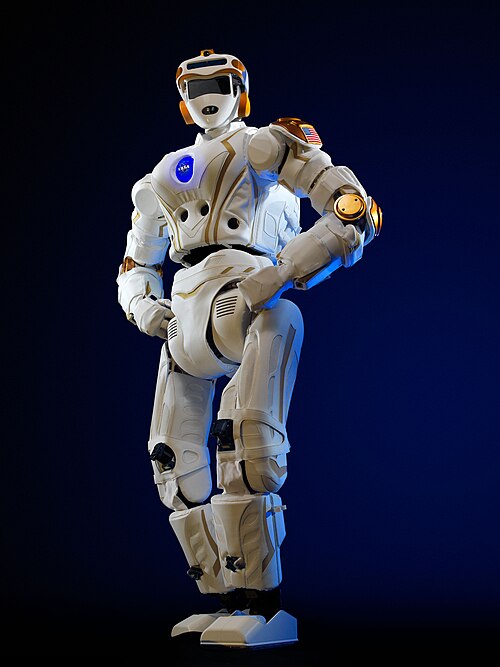
Valkyrie (R5)
NASA · USA · since 2013
prototypeA fully electric humanoid from NASA's Johnson Space Center, built for the DARPA Robotics Challenge Trials in 2013. The team later improved it, and it serves as a research platform, among other things for the Space Robotics Challenge.
In the History of robots: 2013 – NASA's Valkyrie in the DARPA competition
| degrees of freedom | 44 [1] [2] |
|---|---|
| height | 6 ft 2 in (approx. 1.88 m) (according to the manufacturer) [1] |
| weight | 300 lb (approx. 136 kg) (according to the manufacturer) [1] |
NEURA 4NE1 (3. generace)
NEURA Robotics · Germany · since 2025
on saleThe third generation of the 4NE1 humanoid (“For Anyone”) from NEURA Robotics of Metzingen, which premiered at the Automatica trade fair in June 2025. It has an Omnisensor, seven cameras and a dual-battery system for continuous operation.
Price: from ≈ 1,462,000 CZK (pre-order)
Sources: The Robot Report – NEURA Robotics launches latest cognitive robots, Neuraverse ecosystem · Messe München / automatica – NEURA Robotics press release: dritte Generation des 4NE1 · Wikipedie – Neura Robotics
| payload | up to 100 kg (joint lifting capacity) (according to the manufacturer) [1] |
|---|
Bumi
Noetix Robotics · China · since 2025
on saleA small consumer humanoid from the Beijing company Noetix for families and teaching at less than 10,000 yuan. The first batch of 500 units sold out in pre-orders in two days.
| height | 0,94 m [1] [2] |
|---|---|
| price | 9 998 CNY (2025) [1] [2] |
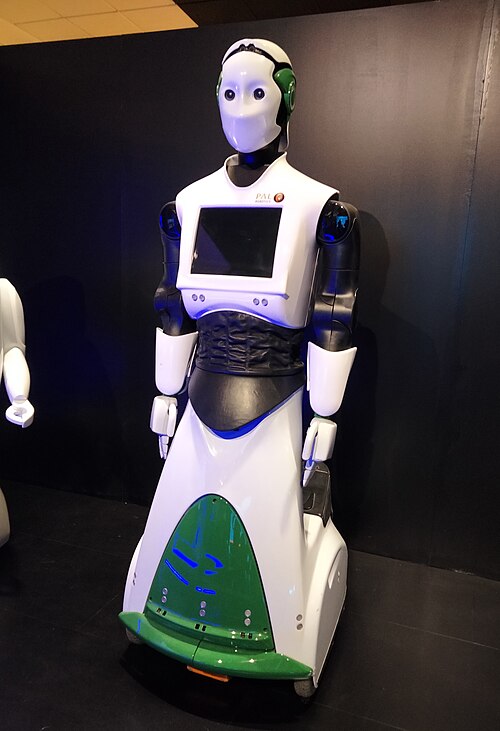
REEM
PAL Robotics · Spain · since 2012
discontinuedA service humanoid from Spain's PAL Robotics on a wheeled base, with a touch screen on its torso and movable arms and head. It was intended as an information point, a guide and for carrying small items.
Sources: PAL Robotics – PAL Robotics launches new humanoid robot prototype REEM · PAL Robotics – Meet REEM, our new service robot! · Wikipedie – REEM · PAL Robotics – timeline, REEM debut in 2012
| height | 1,65 m (according to the manufacturer) [1] |
|---|---|
| degrees of freedom | 22 [1] [2] |
| speed | 5 km/h (according to the manufacturer) [1] |
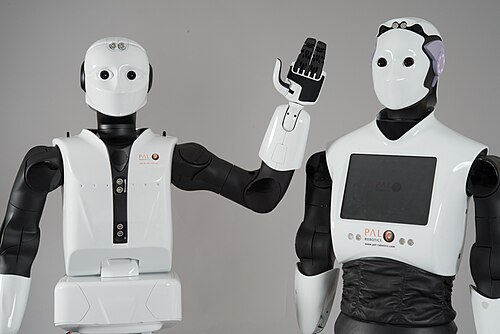
REEM-C
PAL Robotics · Spain · since 2013
discontinuedAn adult-sized bipedal humanoid from PAL Robotics, built as a research platform fully based on ROS. It can walk, climb stairs and grasp objects.
Sources: PAL Robotics – REEM-C · ROS.org – PAL Robotics announces the REEM-C · IEEE ROBOTS Guide – REEM-C · PAL Robotics – Unplug and play with REEM-C humanoid robot!
| height | 1,65 m [1] [2] [3] |
|---|---|
| weight | 80 kg [1] [2] |
| degrees of freedom | 68 [1] [2] |
| battery life | 3 h walking / 6 h idle (according to the manufacturer) [1] |
| speed | up to 2.5 km/h (according to the manufacturer) [1] |
| payload | 1 kg (arm extended) (according to the manufacturer) [1] |
TALOS
PAL Robotics · Spain · since 2017
on saleA bipedal research humanoid from PAL Robotics with torque sensing in its joints, designed for dynamic walking and working with heavier tools in industry. Its software is built on ROS.
| height | 1,75 m [1] [2] |
|---|---|
| degrees of freedom | 32 (according to the manufacturer) [1] |
| payload | 6 kg per arm (extended) (according to the manufacturer) [1] |
| battery life | 1.5 h walking / 3 h idle (according to the manufacturer) [1] |
Reachy 2
Pollen Robotics (Hugging Face) · France · since 2024
on saleAn open humanoid for research and teaching from the Bordeaux company Pollen Robotics, which Hugging Face bought in April 2025. It is used, among others, by laboratories at Cornell University and Carnegie Mellon.
| price | 70 000 USD (2025) [1] [2] |
|---|
RB-Y1
Rainbow Robotics · South Korea · since 2024
on saleA dual-arm humanoid manipulator on a fast wheeled base from Rainbow Robotics of Daejeon. The company publicly showed it in March 2024 at the SF+AW 2024 trade fair and published specifications in April 2024.
| degrees of freedom | 7 per arm [1] [2] |
|---|
RP1 (ROBOTO 01)
RoboParty · China · since 2026
prototypeA bipedal platform for research and teaching introduced at IROS. The project publishes design files, electronics and control software. The demonstration included maintaining balance under external impacts.
STAR1
Robot Era · China · since 2024
prototypeA bipedal humanoid from Robot Era, which emerged from Tsinghua University in 2023. In October 2024 it ran in the Gobi Desert at up to 3.6 m/s, though wearing shoes.
| height | 1,71 m [1] [2] |
|---|---|
| weight | 65 kg [1] [2] |
| speed | 3,6 m/s [1] [2] |
Phoenix
Sanctuary AI · Canada · since 2023
prototypeThe sixth generation of the general-purpose humanoid from Canada's Sanctuary AI, controlled by the Carbon system and equipped with hands with 20 degrees of freedom and haptic feedback. When it was introduced, it moved on a wheeled base, not on legs.
Sources: Sanctuary AI – Sanctuary AI Unveils Phoenix · IEEE Spectrum – Sanctuary’s Humanoid Robot Is for General-Purpose Autonomy · TechCrunch – Sanctuary AI’s new humanoid robot stands 5’7" and lifts 55 lb
| height | 1,70 m [1] [2] [3] |
|---|---|
| weight | 70,3 kg [1] [2] |
| payload | 24,9 kg [1] [2] |
| speed | 4,8 km/h [1] [2] |
Dobot Atom
Shenzhen Dobot · China · since 2025
on saleThe first humanoid from collaborative arm maker Dobot, with five-fingered hands and walking with bent knees. Pre-sales began in March 2025 and the company announced mass production from mid-2025.
| height | 1,53 m [1] [2] |
|---|---|
| weight | 62 kg [1] [2] |
| degrees of freedom | 41 [1] [2] |
| price | approx. 199,000 CNY (2025) [1] [2] |
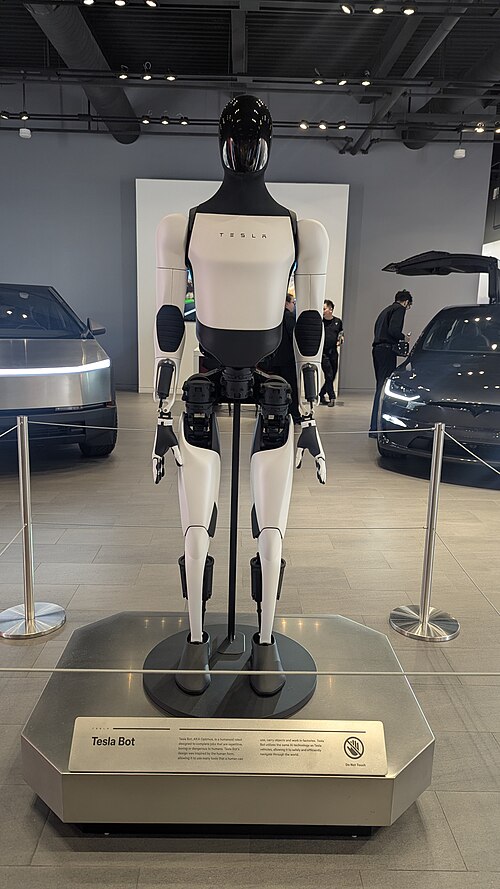
Optimus
Tesla · USA · since 2022
prototypeTesla's general-purpose humanoid, announced in 2021 and first shown as a prototype at AI Day 2022. Its early production began in Fremont in October 2026; Tesla expects sales to other companies around the end of 2027.
In the History of robots: 2026 – Tesla announces that Optimus production has begun in Fremont
T-HR3
Toyota · Japan · since 2017
prototypeThe third generation of Toyota's humanoid, controlled remotely by an operator through the Master Maneuvering System with force feedback. The robot has 32 torque-controlled axes and two hands with ten fingers.
Sources: Toyota – Toyota Unveils Third Generation Humanoid Robot T-HR3 · IEEE Spectrum – Toyota Gets Back Into Humanoid Robots With New T-HR3
| weight | 75 kg [1] [2] |
|---|---|
| degrees of freedom | 32 [1] [2] |
| height | 1,54 m (according to the manufacturer) [1] |
UBTECH Walker S2
UBTECH Robotics · China · since 2025
on saleAn industrial humanoid that, according to the manufacturer, can swap its own battery. In November 2025, UBTECH began mass production and deliveries of the first several hundred units, and orders for the Walker series for 2025 exceeded 800 million yuan.
Price: from ≈ 980,000 CZK (media estimate)
Sources: UBTECH / PR Newswire – Walker S2 Begins Mass Production and Delivery · AI Business – UBTech Completes First Mass Humanoid Robot Delivery · UBTECH – Walker S2 (official page) · UBTECH – annual results for 2025, introduction of Walker S2, page 3
| payload | 15 kg (according to the manufacturer) [1] |
|---|
UWORLD U1
UBTECH Robotics · China · since 2026
prototypeA series of social humanoids with a biomimetic appearance introduced in Shenzhen. It includes the U1 Lite torso and full-body Pro and Ultra variants. The manufacturer offers it for companionship, reception and interaction with people.
Sources: UBTECH via PR Newswire – UWORLD U1 series · Tom's Guide – introduction of the UWORLD U1 series
| price | from 119 800 CNY for the series (introductory price, June 2026) (according to the manufacturer) [1] |
|---|
Walker C1
UBTECH Robotics · China · since 2026
prototypeA full-bodied humanoid focused on communication and services in public settings. The manufacturer offers motion customisation and an SDK interface. The robot made its public debut at the fourth CISCE supply chain expo.
Walker S
UBTECH Robotics · China · since 2023
pilot deploymentAn industrial humanoid from UBTECH, first shown on 29/12/2023 when the company listed on the Hong Kong stock exchange. In 2024 it was trained at a factory of the carmaker NIO for quality inspection and attaching badges.
Sources: UBTECH – As Walker S Strikes the Gong, UBTECH Robotics Becomes the First Humanoid Robot Company Listed on the HKEX · Cailian Press (STAR Market Daily) – UBTech Walker S starts an internship at a car plant · Tencent News (Keji Xingzhe) – interview with UBTech's Jiao Jichao · UBTECH – Walker S
| height | 1,70 m [1] [2] |
|---|---|
| degrees of freedom | 41 servo joints (according to the manufacturer) [1] |
Walker S1
UBTECH Robotics · China · since 2024
pilot deploymentAn industrial humanoid from UBTECH, officially introduced in October 2024, which underwent training in BYD and Zeekr factories. It cooperates with autonomous logistics vehicles.
Walker X
UBTECH Robotics · China · since 2021
on saleA bipedal service humanoid from UBTECH introduced in 2021, with 41 servo joints and fingers on its hands. It demonstrated climbing stairs, playing chess and hand-eye coordination.
Price: from ≈ 3,247,000 CZK (seller’s price)
Sources: Inceptive Mind – UBTECH Robotics unveils its new intelligent humanoid service robot · Tencent News (Keji Xingzhe) – interview with UBTech's Jiao Jichao · Robot-China.com (via People's Daily Online) – 41 domestically made joints for a robot · UBTECH – Walker X
| height | 1,30 m [1] [2] [3] |
|---|---|
| weight | 63 kg [1] [2] [3] |
| degrees of freedom | 41 servo joints [1] [2] [3] |
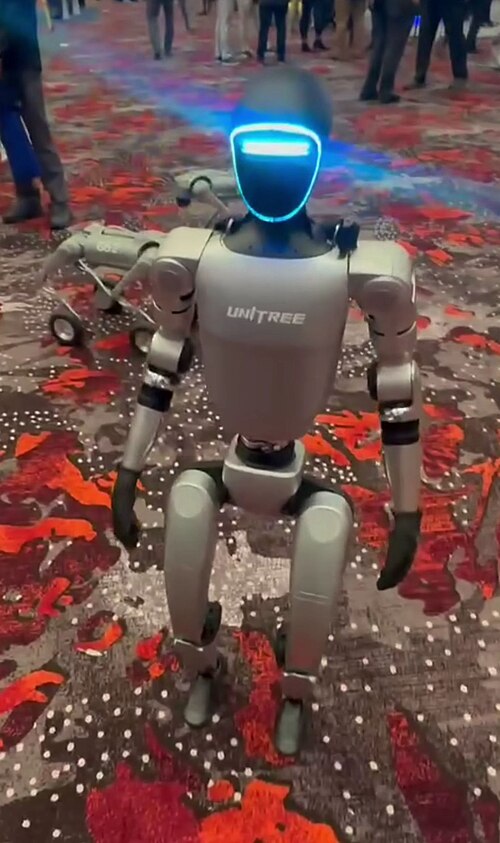
G1
Unitree Robotics · China · since 2024
on saleA compact humanoid from Hangzhou, sold since 2024 mainly for research and teaching at a price of around 16,000 USD. In the EDU version it has up to 43 degrees of freedom.
Price: from ≈ 294,000 CZK (manufacturer’s price list)
In the History of robots: 2024 – Unitree presents G1
Sources: Ars Technica – You can now buy a 4-foot-tall humanoid robot for $16K · Unitree Robotics – G1 · Wikipedie – Unitree Robotics
| height | 1,32 m (according to the manufacturer) [1] |
|---|---|
| weight | approx. 35 kg (according to the manufacturer) [1] |
| payload | approx. 2 kg (arm, EDU approx. 3 kg) (according to the manufacturer) [1] |
| degrees of freedom | 23 (according to the manufacturer) [1] |
| battery life | approx. 2 h (according to the manufacturer) [1] |
| price | approx. 16,000 USD (2024) [1] [2] |
H1
Unitree Robotics · China · since 2023
on saleUnitree's first full-size humanoid, introduced in August 2023, with M107 joint motors of its own design. The manufacturer states a movement speed of 3.3 m/s.
Price: from ≈ 1,963,000 CZK (manufacturer’s price list)
In the History of robots: 2023 – Unitree presents H1
Sources: The Robot Report – Unitree teases new H1 humanoid robot · Caiwen News – Unitree unveils its first humanoid robot · Unitree Robotics – H1
| height | 1,80 m [1] [2] |
|---|---|
| weight | 47 kg [1] [2] |
| speed | 3,3 m/s (according to the manufacturer) [1] |
H2 Plus
Unitree Robotics · China · since 2026
prototypeA research variant of the H2 humanoid combines a Unitree body, tactile five-fingered Sharpa hands and an NVIDIA computing platform. The reference configuration is intended for developing and validating robotic skills.
| degrees of freedom | 75 including both Sharpa Wave hands (according to the manufacturer) [1] |
|---|
H2-X
Unitree Robotics · China · since 2026
prototypeA bipedal humanoid shown in a video featuring combat movements and scenes of protecting a person. The public showcase from October 2026 documents a development demonstration whose intended security use is described by the manufacturer.
Unitree H2
Unitree Robotics · China · since 2025
on saleA full-size humanoid from Unitree introduced in October 2025, so far its tallest robot. It has a bionic head with facial features, and the manufacturer offers it at a fixed price.
Price: from ≈ 652,000 CZK (manufacturer’s price list)
Sources: TechNode – Unitree unveils H2 humanoid robot · South China Morning Post – Unitree Robotics unveils next-gen humanoid · Unitree – H2 (official page)
| height | 1,80 m [1] [2] |
|---|---|
| weight | 70 kg [1] [2] |
| degrees of freedom | 31 [1] [2] |
| battery life | approx. 3 h (according to the manufacturer) [1] |
| price | 29 900 USD (2026) (according to the manufacturer) [1] |
Unitree R1
Unitree Robotics · China · since 2025
on saleA lightweight, low-cost humanoid from Unitree launched on 25 July 2025 at a price from 39,900 yuan. It has a multimodal language model for voice and vision and is intended mainly for developers and teaching.
Price: from ≈ 107,000 CZK (manufacturer’s price list)
Sources: Shanghai Metals Market – Unitree releases its third humanoid robot, Unitree R1 · Unitree – R1 (official page) · TechNode – Unitree unveils H2 humanoid robot
| height | 1,23 m (according to the manufacturer) [1] |
|---|---|
| weight | approx. 29 kg (according to the manufacturer) [1] |
| degrees of freedom | 26 (according to the manufacturer) [1] |
| price | from 5,900 USD (2026) (according to the manufacturer) [1] |
WABOT-1
Waseda University · Japan · since 1973
discontinuedA humanoid from Japan's Waseda University, completed in 1973 under the leadership of Professor Ichiro Kato and considered the first full-size humanoid robot. It could walk on two legs, grasp an object with its hands and speak simple Japanese.
In the History of robots: 1973 – The WABOT-1 humanoid
Isaac 1
Weave Robotics · USA · since 2026
prototypeA wheeled home robot with a head, a height-adjustable torso and two arms. It is intended for handling laundry and tidying up objects. The manufacturer is accepting pre-orders and plans to use remote assistance for difficult tasks.
Sources: Weave Robotics – Isaac 1, specifications and pre-orders · TechRadar – introduction of Isaac 1, 2/7/2026
| price | Announced price of 7 999 USD or a subscription of 449 USD per month (according to the manufacturer) [1] |
|---|---|
| battery life | 8 hours according to the manufacturer (according to the manufacturer) [1] |
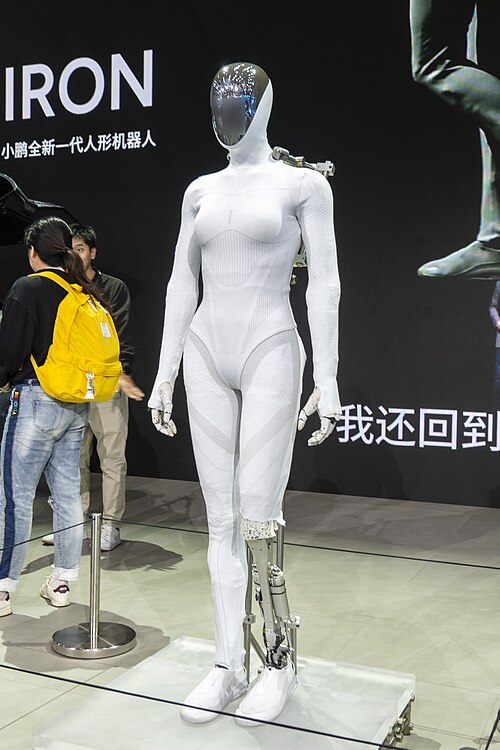
IRON
XPENG · China · since 2024
pilot deploymentA humanoid from the Chinese carmaker XPENG, introduced at AI Day in November 2024 and deployed in its factory in Guangzhou. In September 2026 XPENG launched a production line for the new generation, and it plans to start mass production by the end of 2026.
In the History of robots: 2026 – IRON leaves XPeng's new production line
Sources: XPENG – XPENG AI Day 2024 (press release) · Pandaily – XPeng Iron L3 Humanoid Robot Will Be Mass-Produced Next Year · Sina Tech (IT Home) – Xpeng AI robot Iron debuts · XPENG – XPENG IRON Humanoid Robot Now Walks Off the Production Line
| height | 1,78 m [1] [2] |
|---|---|
| weight | 70 kg [1] [2] |
| degrees of freedom | 62 active (1st generation) [1] [2] |
| degrees of freedom | 76 (new generation, 21 per hand) (according to the manufacturer) [1] |
Robot comparison
Catalogue data side by side; the sources are on the robot cards and detail pages. The link to this page can be shared.
Facts and records
Calculated from verified data in the catalogue and the History of robots. Click a robot to see the sources.
up to 100 kg(joint lifting capacity)Highest payloadNEURA 4NE1 (3. generace) (NEURA Robotics)according to the manufacturer
8 hLongest battery lifeForerunner K2 „Bumblebee“ (Kepler Robotics (Shanghai Kepler Robotics Co., Ltd.))
1206Oldest milestone in the History of robotsAl-Jazari's Book of Knowledge of Ingenious Mechanical Devices
27 of 78robots in the catalogue are for sale
ChinaCountry with the most robots in the catalogue (35)
UBTECH RoboticsCompany with the most robots in the catalogue (6)
Glossary of terms
- Actuatoractuator
A device that converts supplied energy into motion or force. In a robot, for example, it bends a joint or opens a gripper.
- Autonomyautonomy
A robot's ability to carry out tasks without continuous control by a human. Its extent depends on the task and the environment; walking on its own does not yet mean handling the whole job on its own.
- Battery runtimebattery runtime
The time a robot can work on a single charge. It depends on both the battery capacity and the consumption during a specific activity, such as walking, carrying a load or waiting.
- Bipedal locomotionbipedal locomotion
Walking on two legs, in which the robot alternates support and shifts its weight between its feet. It requires coordinating joint movements and continuously maintaining balance.
- Collaborative robotcollaborative robot
A robot designed to work with a person in a shared workspace. Safe operation also depends on the tool, the task and the risk assessment of the entire workplace.
- Degree of freedomdegree of freedom (DOF)
One independent way in which a body or mechanism can move, for example rotation around an axis. The number of degrees of freedom expresses how many independent coordinates are needed to describe its position.
- Depth cameradepth camera
A camera that, in addition to or instead of an image, provides the distance of individual parts of the scene. It helps a robot estimate the shape and position of objects and recognise obstacles in space.
- Digital twindigital twin
A digital model of a specific machine or workplace, linked to data from its real operation. It helps monitor the state of equipment, try out changes and estimate their effects.
- Dynamic balancedynamic balance
Maintaining stability during movement through continuous changes in posture, forces and foot placement. This lets a robot handle a step or a disturbance, even if in some momentary position it could not stand still.
- Encoderencoder
A sensor that converts position or a change in position into an electrical signal. In a robot joint, it helps determine the angle of rotation and provides feedback for precise motion control.
- End effectorend effector
The working part at the end of a robotic arm that acts directly on the surroundings. It can be, for example, a gripper, a robotic hand or a tool for a specific task.
- End-to-end controlend-to-end control
An approach in which a model learns to convert inputs, such as an image and a task description, into output actions as a whole. The output can be movement targets, which are then processed by motor control.
- Force sensorforce sensor
A sensor that measures an applied force. A robot can use it, for example, to control pressing force during manipulation; combined force-torque sensors also measure the rotational effects of forces.
- Hydraulic actuationhydraulic actuation
A drive that transfers energy through pressurised fluid to cylinders or hydraulic motors. It can produce great force, but it also requires a pressure source, lines and seals.
- Imitation learningimitation learning
A method in which a robot learns from demonstrations of how to perform a task correctly. The demonstrations can come, for example, from teleoperation and are used to learn a procedure for similar situations.
- Inertial measurement unit (IMU)inertial measurement unit (IMU)
A set of sensors that measures acceleration and angular velocity, i.e., how fast a body is rotating. From this data, the control system estimates the robot's tilt and changes in its movement, which helps maintain balance.
- Lidarlight detection and ranging (lidar)
A sensor that uses laser light to measure the distance to surrounding surfaces. From many measurements, it creates a spatial overview that the robot uses for orientation and avoiding obstacles.
- Model predictive control (MPC)model predictive control (MPC)
Control that uses a model to predict the near-future motion and looks for suitable actions with regard to goals and constraints. It continuously recalculates the plan based on new measurements, for example when balancing a robot.
- Pilot deploymentpilot deployment
Limited trial use of a robot in real operation. It serves to verify its usefulness, reliability and safety before any wider rollout.
- Planetary gearboxplanetary gearbox
A gearbox with a central gear around which smaller gears orbit inside a toothed ring. In robot drives, it can reduce motor speed and increase the available torque.
- Quasi-direct drivequasi-direct drive
A drive that combines a motor with a gearbox with a low gear ratio. It allows quick response to contact with the surroundings and makes force control easier, but it requires a motor able to deliver enough torque.
- Reinforcement learningreinforcement learning
A method in which a system learns to choose actions based on the rewards received for their results. In this way, a robot can gradually learn walking or manipulation in simulation by trying different approaches.
- Robot as a service (RaaS)robot as a service (RaaS)
A way of providing a robot in which the customer pays for its use or for the work done instead of buying it outright. The service can also include maintenance, software and operational support.
- Robotic handrobotic hand
In humanoids, the part at the end of the arm designed for grasping and handling objects, often equipped with movable fingers. Its capabilities depend on its design, sensors and control method.
- Robotics foundation modelrobotics foundation model
An artificial intelligence model pre-trained on a broad range of data and tasks, which can be further adapted to various robotic activities. It provides a common foundation of skills but does not guarantee mastery of any arbitrary task.
- Safety standardsafety standard
A document setting out requirements or procedures for reducing risks in the design and use of equipment. For robots, it helps address issues such as dangerous contact with a person; meeting a standard does not by itself guarantee safety in every situation.
- Servomotorservomotor
A motor used with a sensor and a controller that compares the desired and actual state and adjusts the drive. Thanks to this feedback, it is possible to precisely control, for example, the position or speed of a joint.
- Sim-to-real transfersim-to-real transfer
Transferring a skill or control method from a virtual environment to a real robot. It requires dealing with differences between the model and reality, for example in friction, measurement or motor response.
- Simulatorsimulator
A program that imitates a robot, its surroundings and their interaction. It allows control to be tested and skills to be learned without wearing out the real machine, but the results need to be verified in reality.
- Strain wave gearingstrain wave gearing
A gearbox in which a flexible gear is deformed in a controlled way and meshes with a rigid toothed ring. It allows a large speed reduction in a small space and precise movement of robot joints.
- Tactile sensortactile sensor
A touch sensor that detects contact and, depending on its design, also pressure or shear forces. On a robotic hand, it helps adjust the grip so that an object does not slip or get damaged.
- Teleoperationteleoperation
Remote control of a robot by a person using controllers or motion capture. The operator gets information, for example, from the robot's cameras and controls its activity based on it.
- Torquetorque
A quantity expressing the rotational effect of a force around an axis. It depends on both the size of the force and the length of its lever arm; in a robot joint, it determines how strongly the drive acts against the load.
- Vision-language-action (VLA) modelvision-language-action model
An artificial intelligence model that connects visual inputs, language instructions and robot actions. For example, from an image of a table and a verbal instruction, it can propose the movements needed to grasp an object.
- Zero moment point (ZMP)zero moment point (ZMP)
A point on the ground plane about which the resulting tipping moment of the forces acting on the robot is zero. When walking on a flat surface, it helps the control system plan movement so that the robot keeps its feet supported.