History of robots
Ideas about artificial beings have evolved from the automata of antiquity to today’s humanoids. Along the way came Čapek’s play R.U.R., which gave the world the word robot.
Forerunners (until 1919)
1206
RoboticsAl-Jazari's Book of Knowledge of Ingenious Mechanical Devices
In 1206, the engineer al-Jazari presented his sultan with a book in which he described and drew in detail dozens of his machines, such as water clocks and automata. It is among the most important records of medieval mechanical engineering.
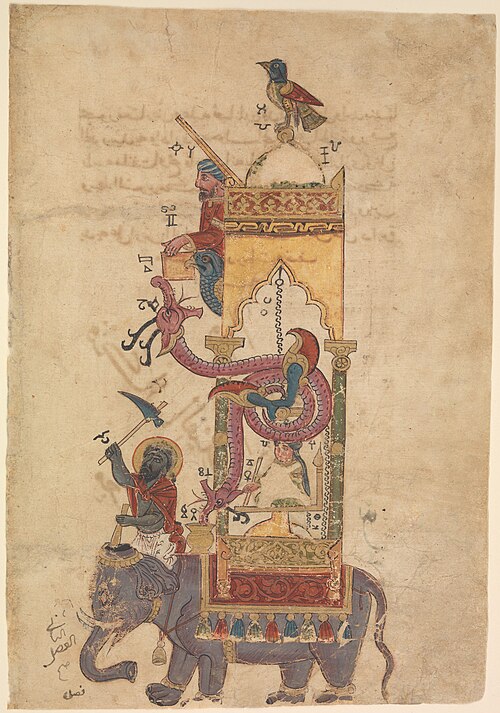
al-Jazari · CC0 · source
around 1495
HumanoidLeonardo's mechanical knight
Around 1495 in Milan, Leonardo da Vinci designed for Duke Ludovico Sforza a mechanical knight in armour that was meant to sit up, move its arms and head, and open its visor. Only fragments of sketches of the design survive, in the Codex Atlanticus.
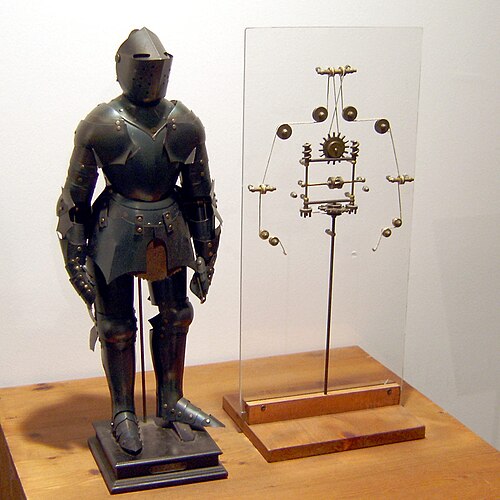
Photo by Erik Möller. Leonardo da Vinci. Mensch - Erfinder - Genie exhibit, Berlin 2005. · Public domain · source
Sources: Medievalists.net: Renaissance Robotics: Leonardo da Vinci's Lost Knight and Enlivened Materiality · Mark Elling Rosheim (Ross-Hime Designs): Leonardo's programmable automaton, a reconstruction · Springer: Rosheim, Leonardo's Lost Robots – kapitola Leonardo's Knight · Moran, M. E.: Evolution of robotic arms (Journal of Robotic Surgery, PMC) · Wikipedie: Leonardo's robot1738
HumanoidVaucanson's flute player and its description
In 1738, Jacques de Vaucanson presented to the Paris Academy of Sciences a human-shaped automaton that played the flute, and published its description, Le mécanisme du fluteur automate. In its record of 30 April 1738, the Academy praised how the machine imitated the player's fingers, breath and lips.
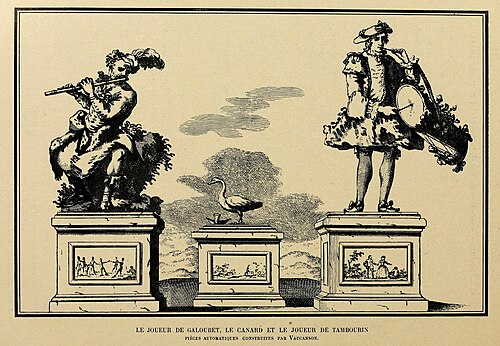
Jacques de Vaucanson · Public domain · source
1774
HumanoidDemonstration of the Jaquet-Droz automata
The Writer, the Draughtsman and the Musician automata were demonstrated in La Chaux-de-Fonds. The mechanical figures imitated writing, drawing and playing a keyboard instrument.
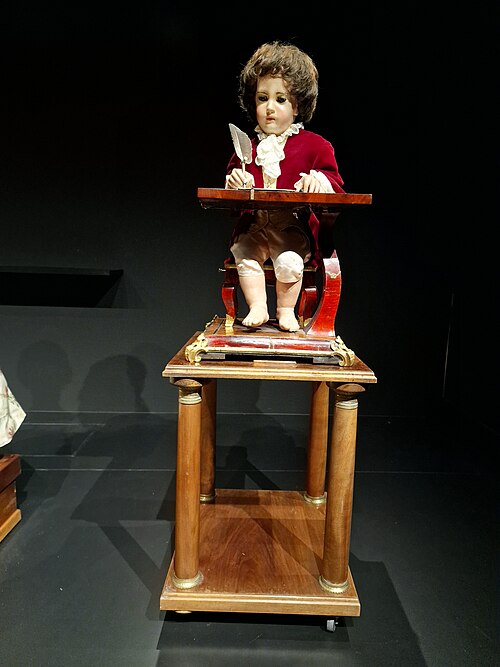
Gre regiment · CC BY-SA 4.0 · source
around 1800
HumanoidMaillardet's drawing and writing automaton
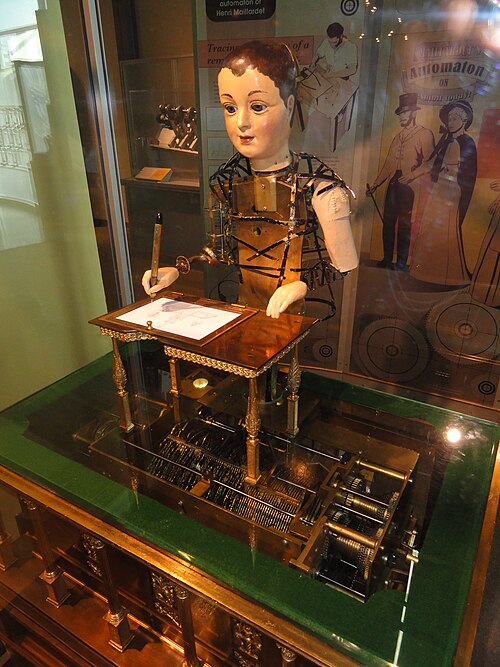
Around 1800 in London, the Swiss mechanic Henri Maillardet built an automaton in the form of a boy that can draw four pictures and write three poems. It has the largest “memory” of all such machines and today belongs to the Franklin Institute in Philadelphia.
Daderot · Public domain · source
1898
RoboticsTesla's radio-controlled boat
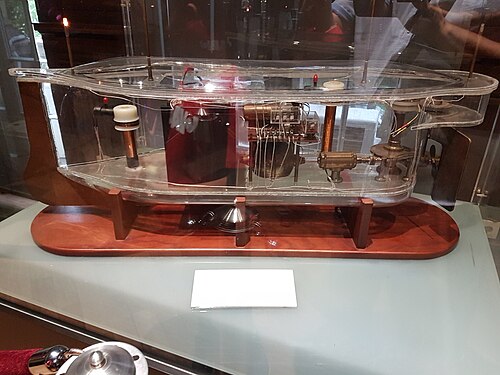
In 1898, at the electrical exhibition in Madison Square Garden in New York, Nikola Tesla steered a model boat with radio signals. It was the first public demonstration of wireless remote control; he was granted patent No. 613,809 on 8 November 1898.
Boban Markovic · CC BY-SA 4.0 · source
The word robot (1920–1959)
1920
CultureKarel Čapek: R.U.R.
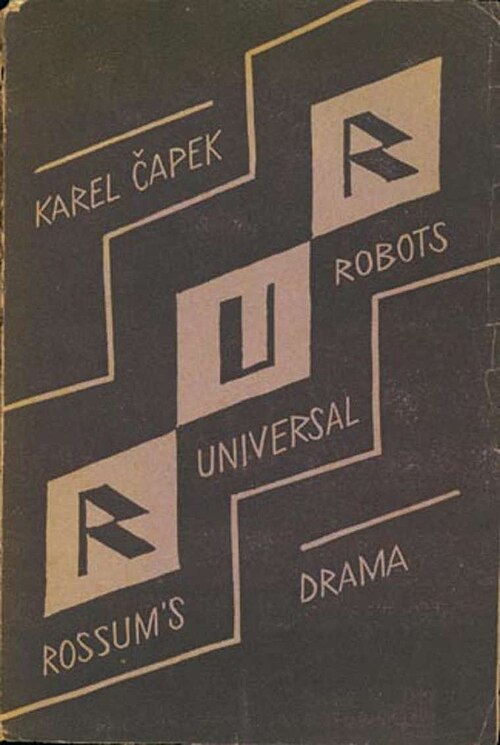
In November 1920, Karel Čapek's play R.U.R. (Rossum's Universal Robots) was published in Prague, giving the world the word robot. It premiered at the National Theatre on 25 January 1921.
Unknown author Unknown author · Public domain · source
1927
CultureThe female robot in Metropolis
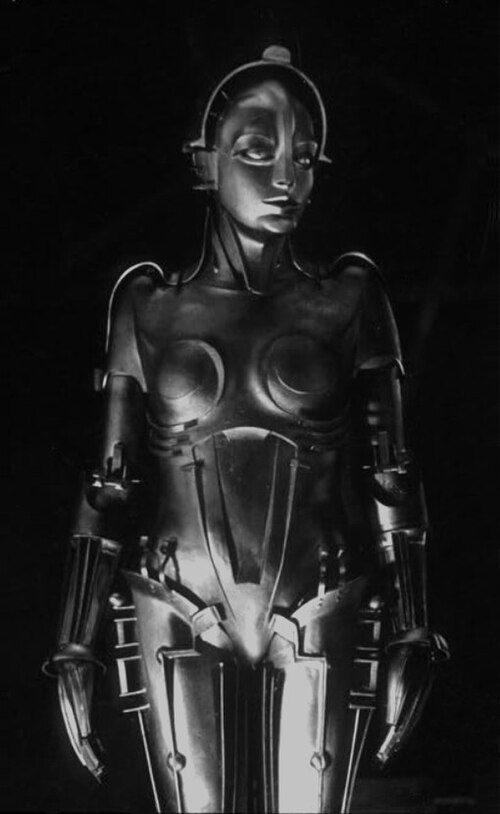
Fritz Lang's film Metropolis premiered. Its female automaton is one of the central characters in the story of a divided industrial society.
Horst von Harbou · Public domain · source
1928
HumanoidEric, the first British robot
In September 1928, the robot Eric opened the Model Engineer Exhibition at London's Royal Horticultural Halls in place of the Duke of York. It was built by Captain W. H. Richards and Alan Reffell; it could stand up, bow, move its arms and give a speech.
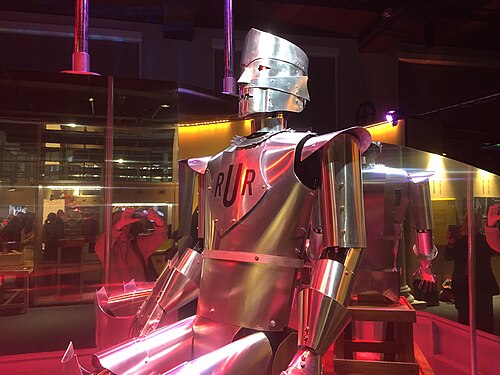
Matt Brown from London, England · CC BY 2.0 · source
1939
HumanoidWestinghouse presents Elektro
At the 1939 World's Fair in New York, the company Westinghouse demonstrated the humanoid robot Elektro. It responded to the rhythm of voice commands and told jokes recorded on gramophone records, and it was accompanied by the robot dog Sparko.
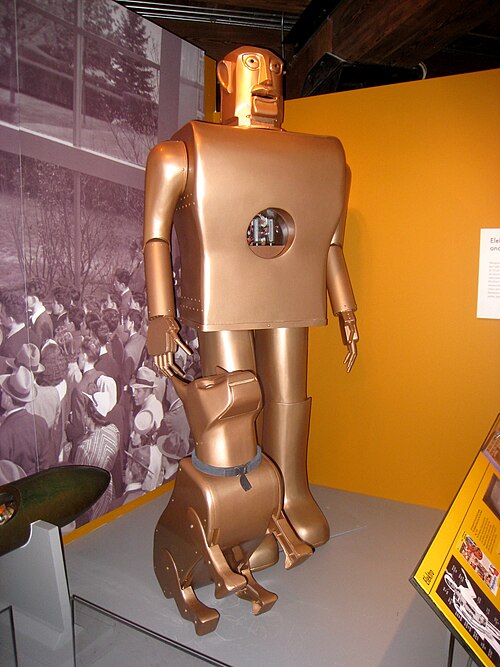
Daderot · Public domain · source
1942
CultureAsimov's story Runaround
In March 1942, Isaac Asimov's story Runaround was published in the magazine Astounding; in it, the three laws of robotics were stated explicitly for the first time. They went on to strongly influence sci-fi and later debates about robotics and artificial intelligence.
1950
CultureIsaac Asimov: I, Robot
The book I, Robot was published, bringing together Asimov's robot stories. Through fiction, it explores the relationships between people and machines.
First machines (1960–1985)
1961
RoboticsUnimate at a car plant
In 1961, Unimate, the first industrial robot used on a production line, began working at the General Motors plant in Trenton, New Jersey. It removed castings from a die-casting machine, which was dangerous and monotonous work.
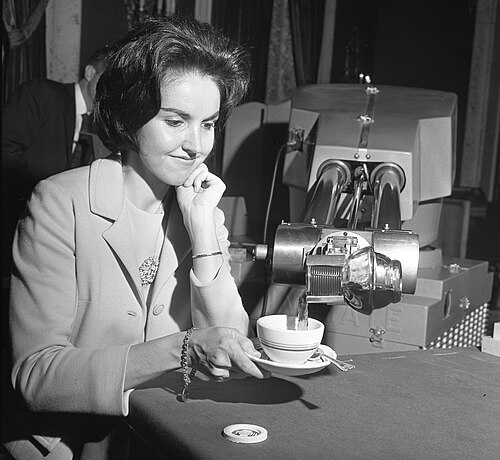
Frank Q. Brown, Los Angeles Times · CC BY 4.0 · source
1963
RoboticsThe Rancho arm at Stanford
The six-jointed Rancho arm was created at the Rancho Los Amigos hospital in Downey, California, as an aid for people with disabilities. In 1963 Stanford University acquired it, and it became one of the first computer-controlled robotic arms.
1965
RoboticsThe pneumatic Orm arm
In 1965 at Stanford, Victor Scheinman and Larry Leifer built the air-powered Orm arm (Norwegian for snake): it moved by inflating 28 bladders between seven metal discs. It is one of the first attempts at an arm controlled directly by a computer, but it was abandoned because its movements were imprecise.
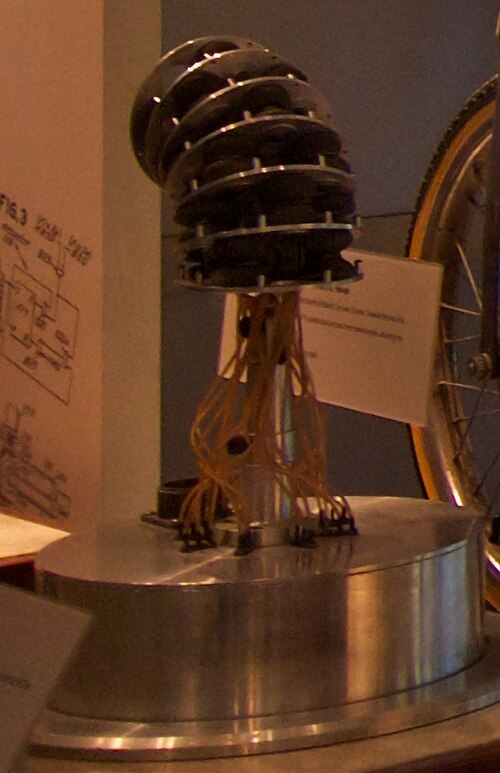
Don DeBold from San Jose, CA, USA · CC BY 2.0 · source
1966
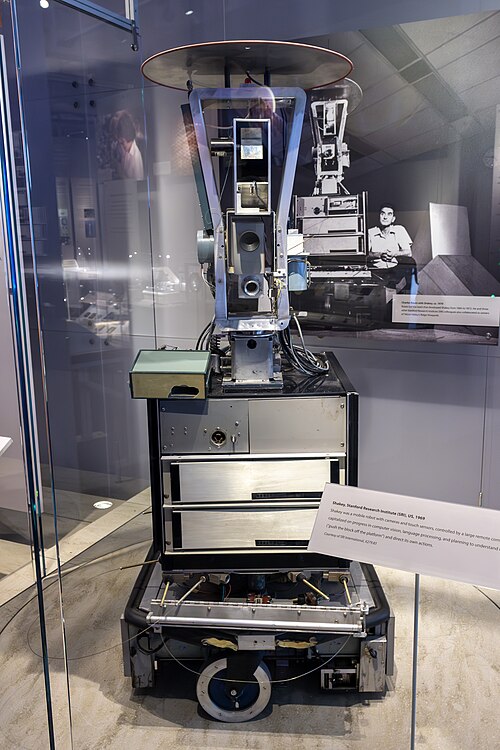
RoboticsStart of the Shakey project
SRI launched the project for the mobile robot Shakey, which continued until 1972. It combined perception of the environment with planning of movement and manipulation.
The wub · CC BY-SA 4.0 · source
around 1968
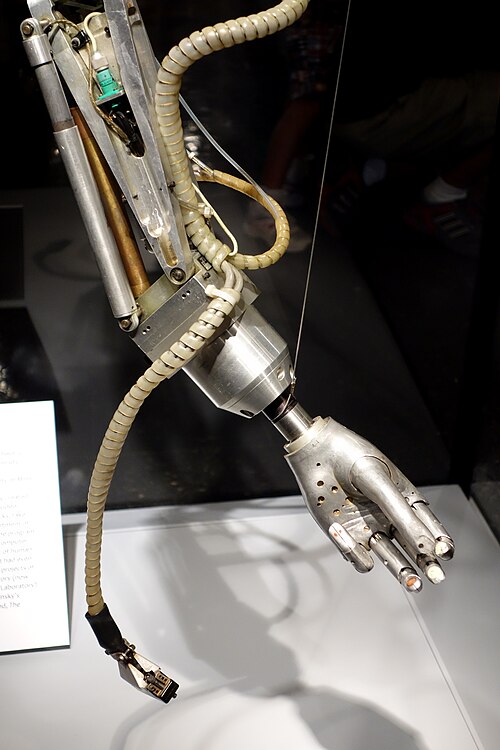
RoboticsMinsky's tentacle arm
Around 1968 at MIT, Marvin Minsky developed a twelve-jointed hydraulic arm that moved like an octopus tentacle and could reach around obstacles. It was controlled by a DEC PDP-6 computer.
Daderot · CC0 · source
1969
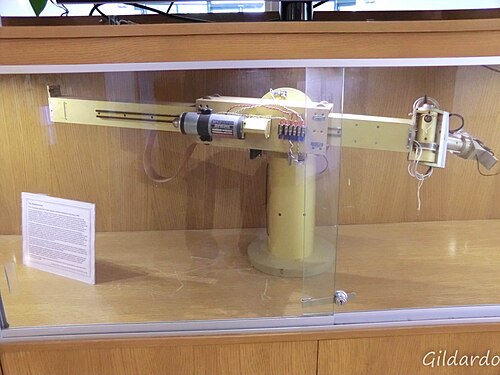
RoboticsThe electric Stanford arm
In 1969 at Stanford, Victor Scheinman designed the six-axis Stanford Arm, the first successful electrically powered, computer-controlled robotic arm. The PUMA industrial robots from Unimation were based directly on it.
Gildardo Sánchez · CC BY 2.0 · source
1973
HumanoidThe WABOT-1 humanoid
In 1973, Waseda University, under the leadership of Professor Ichiro Kato, completed the robot WABOT-1, considered the first full-size humanoid robot. It walked on two legs, grasped objects and communicated in simple Japanese.
1974
RoboticsSilver Arm for fine assembly
At MIT, David Silver developed a robotic arm for assembling small parts. For precise manipulation, it used feedback from touch and pressure sensors.
1977
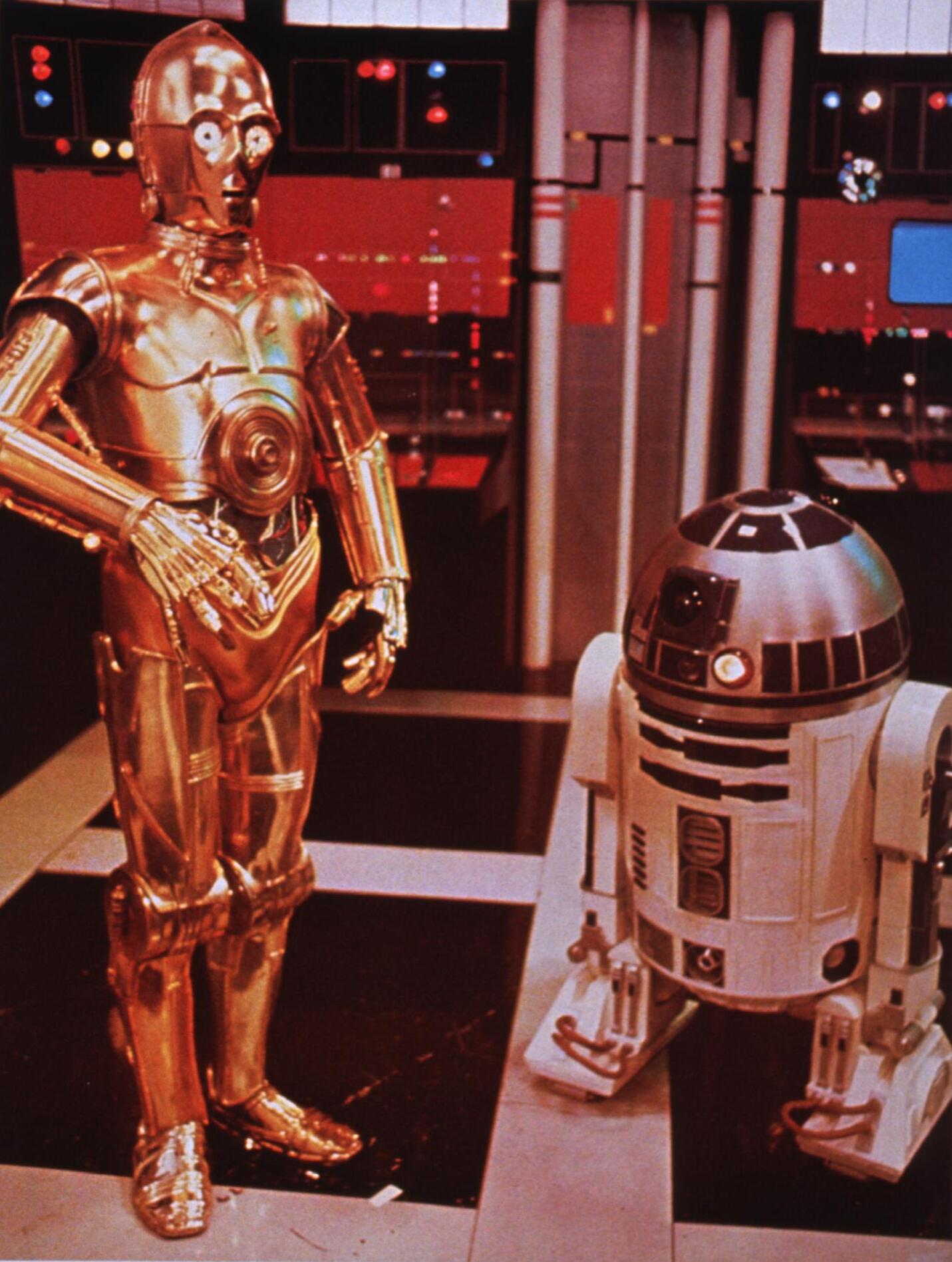
CultureThe droids R2-D2 and C-3PO in Star Wars
George Lucas's film Star Wars (later Episode IV – A New Hope) premiered on 25 May 1977. The droids R2-D2 and C-3PO are among the main characters and strongly influenced how the public imagines robots.
National Library of Medicine - History of Medicine · Public domain · source
1979
RoboticsStanford Cart crosses an obstacle course
In 1979, Hans Moravec's Stanford Cart crossed a room full of obstacles on its own. It used a camera to take stereoscopic images, built a sparse 3D map and planned its route; the crossing took about five hours. It was an early milestone in robot vision and navigation.
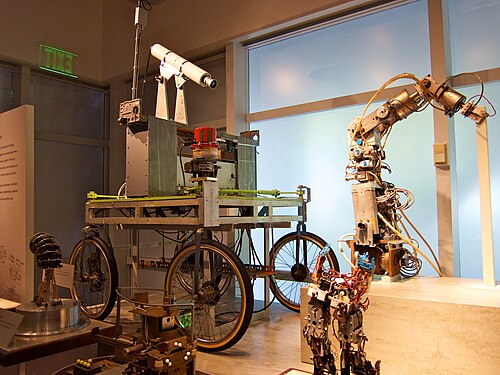
Don DeBold from San Jose, CA, USA · CC BY 2.0 · source
1984
HumanoidThe musician robot WABOT-2
In 1984, Waseda University completed the humanoid robot WABOT-2, which read sheet music with a camera, played an electronic organ with its hands and feet, and spoke Japanese. It built on WABOT-1 and was a first step towards a “personal robot”.
Walking humanoids (1986–2009)
1986
RoboticsHonda begins research into walking
Honda built the experimental bipedal machine E0. With its slow static walking, Honda started a research series that later produced full humanoid figures.
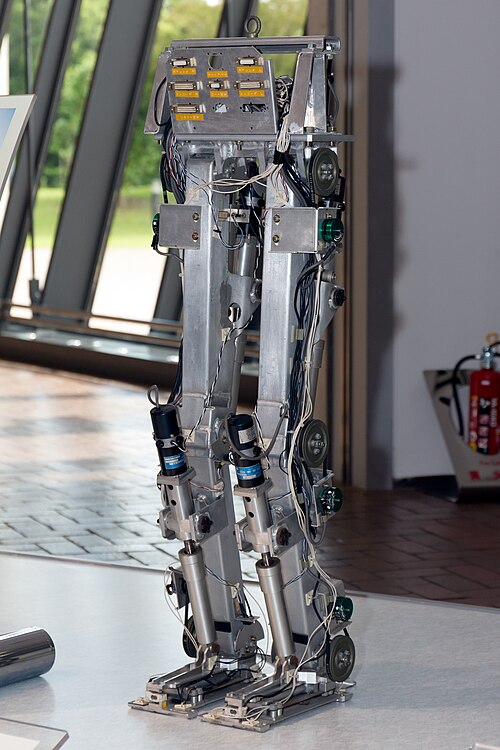
Morio · CC BY-SA 3.0 · source
1993
HumanoidHonda P1 with a torso and arms
In 1993, Honda built the P1 prototype, its first walking machine with a torso, arms and a head. It was 191.5 cm tall, weighed 175 kg and used an external power supply and computer; it was not shown publicly and was used for research.
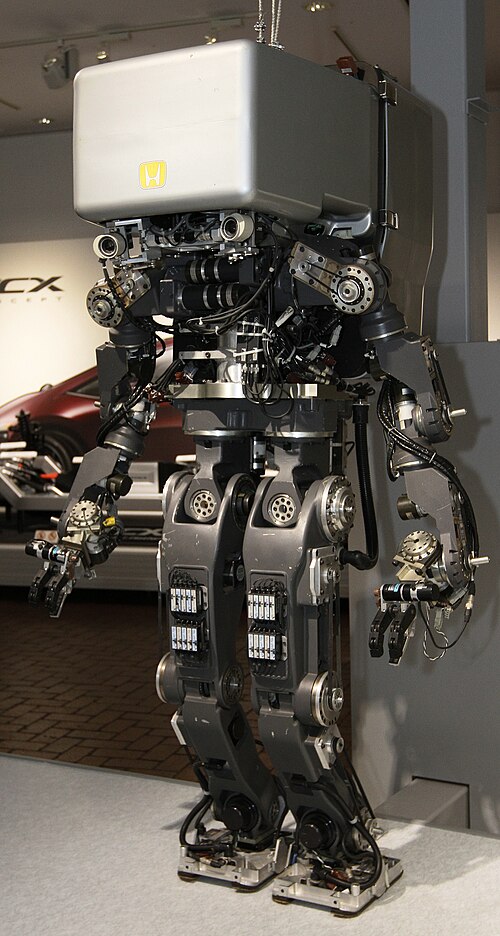
Morio · CC BY-SA 3.0 · source
1996
HumanoidIntroduction of the Honda P2
In December 1996, Honda introduced P2, the first autonomous bipedal humanoid that walked without falling. It carried its computer, drives and batteries in its torso, so it worked without a cable; it could also handle stairs and push a cart.
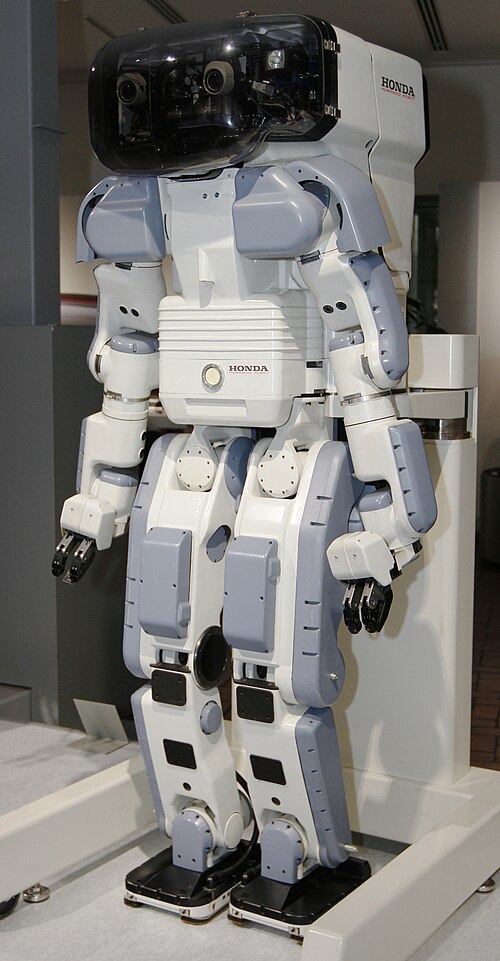
Morio · CC BY-SA 3.0 · source
around 1996
HumanoidWABIAN – a bipedal humanoid from Waseda University
Around 1996, the bipedal humanoid WABIAN, roughly the size of an adult human, was created in Atsuo Takanishi's laboratory at Waseda University. It could walk dynamically forwards and backwards, carry a load and communicate with gestures, and it became the basis of the whole WABIAN series.
1997
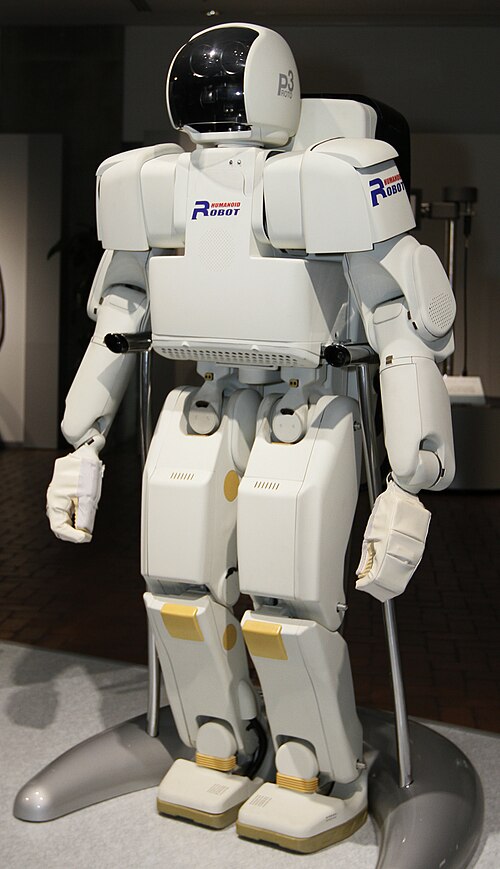
HumanoidCompletion of the Honda P3
In September 1997, Honda completed the fully independent humanoid P3. It was 160 cm tall and weighed 130 kg, making it smaller and lighter than P2 thanks to new materials and distributed control. It became the direct predecessor of the ASIMO robot.
Morio · CC BY-SA 3.0 · source
1997
HumanoidHadaly-2 for collaboration with humans
Waseda introduced the humanoid robot Hadaly-2. The project focused on collaboration between the robot and a human partner.
2000
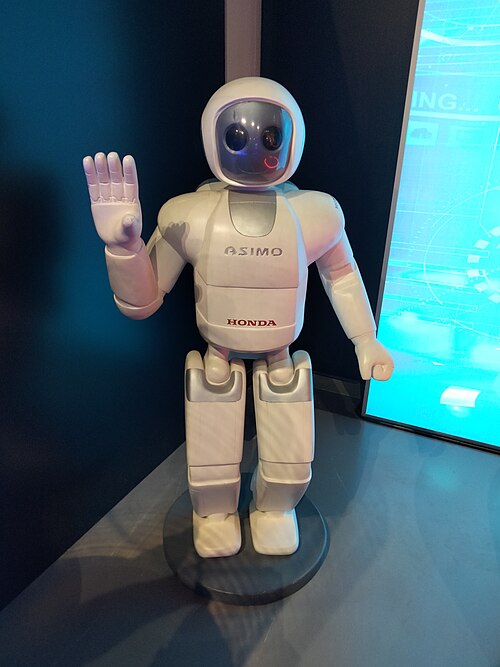
HumanoidHonda presents ASIMO
On 20 November 2000, Honda announced the small, lightweight humanoid ASIMO (Advanced Step in Innovative Mobility), developed from P3. New walking technology gave it unusually human-like movement and a size suitable for human environments.
Enric · CC BY-SA 4.0 · source
2002
HumanoidDebut of the RoboCup humanoid league
The humanoid league was held for the first time at RoboCup in Fukuoka, Japan. The competition created a shared environment for developing humanoid robots with a focus on robot football.
2003
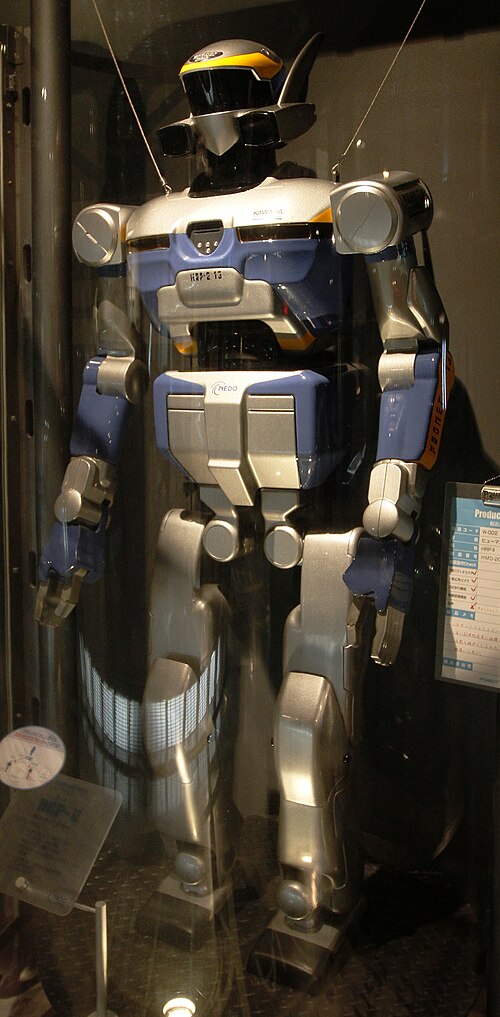
HumanoidHRP-2 as a research platform
The HRP project resulted in the humanoid platform HRP-2, developed by AIST and Kawada Industries. The robot was intended for research into work in human environments.
Morio · CC BY-SA 3.0 · source
2003
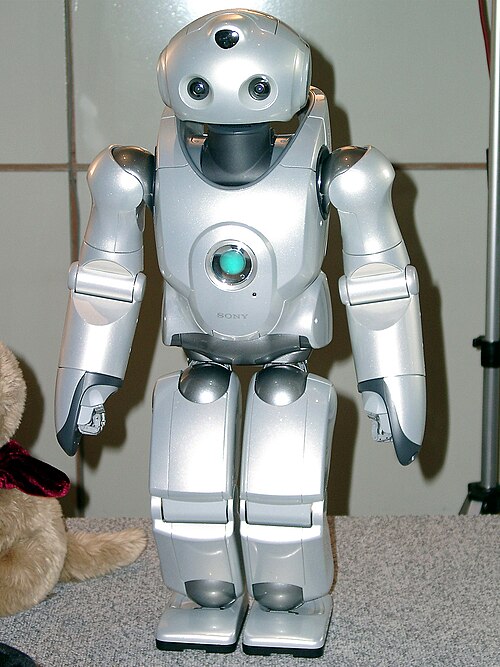
HumanoidQRIO as the first running humanoid
On 18 December 2003, Sony demonstrated the humanoid QRIO running: for a moment, both feet were in the air at the same time. Sony called it the first running autonomous humanoid with its own control and power supply; it ran at about 14 m per minute.
Dschen Reinecke · CC BY-SA 3.0 · source
2004
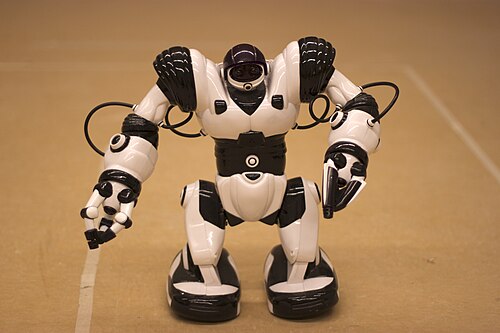
HumanoidRobosapien comes to market
In 2004, the company WowWee released the toy Robosapien, designed by the roboticist Mark Tilden. The humanoid robot walked, grasped objects and had dozens of commands; from April to December 2004, over 1.5 million units were sold.
Jiuguang Wang · CC BY-SA 2.0 · source
2005
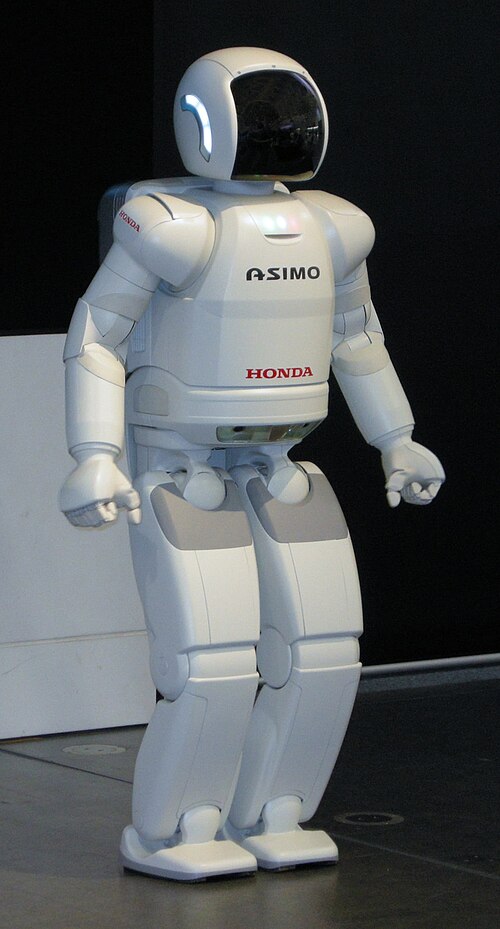
HumanoidNew ASIMO works with people
On 13 December 2005, Honda introduced a new version of ASIMO that could walk hand in hand with a person, push a cart, carry a tray and work on its own as a receptionist or guide. It ran at 6 km/h and could run in a circle.
Hatsukari715 · Public domain · source
2008
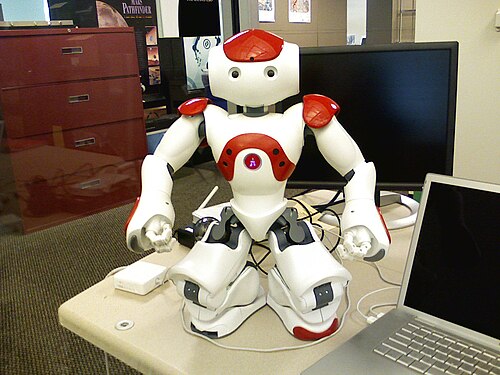
HumanoidNAO in the RoboCup Standard Platform League
The NAO humanoid from the French company Aldebaran replaced the AIBO dog as the common platform of the RoboCup Standard Platform League and first competed in it in 2008. The choice, announced in August 2007, made NAO a standard research robot.
Jiuguang Wang · CC BY-SA 3.0 · source
2008
HumanoidFirst version of the open iCub platform
The first version of the iCub humanoid from the European RobotCub project was released. The child-sized robot combined modular construction and open software for research into learning and cognition. Researchers could modify its components and jointly develop the platform.
2009
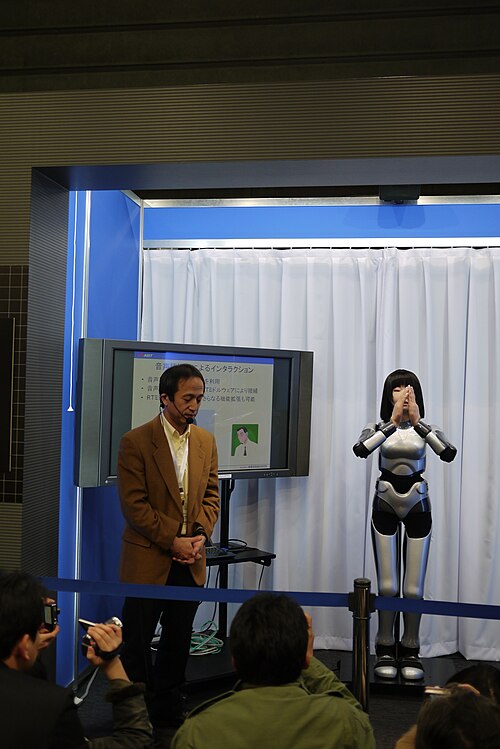
HumanoidIntroduction of the HRP-4C humanoid
AIST introduced the humanoid robot HRP-4C with a human face and figure. Development aimed at imitating human movement and use in the entertainment industry.
yoggy0 from Yokohama, Japan · CC BY 2.0 · source
Research and dynamics (2010–2019)
2010
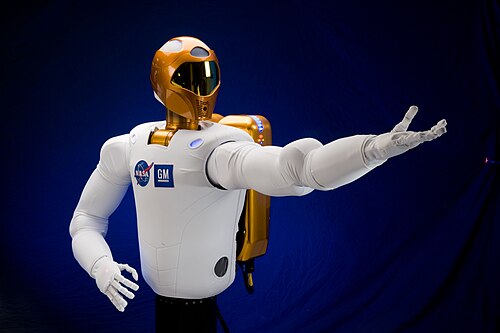
HumanoidIntroduction of Robonaut 2
On 4 February 2010, NASA and General Motors introduced the humanoid Robonaut 2 (R2), a faster and more dexterous successor to the original Robonaut. It had a head, torso, two arms and hands and was designed to work safely alongside people in space and in factories.
Robert Markowitz · Public domain · source
2011
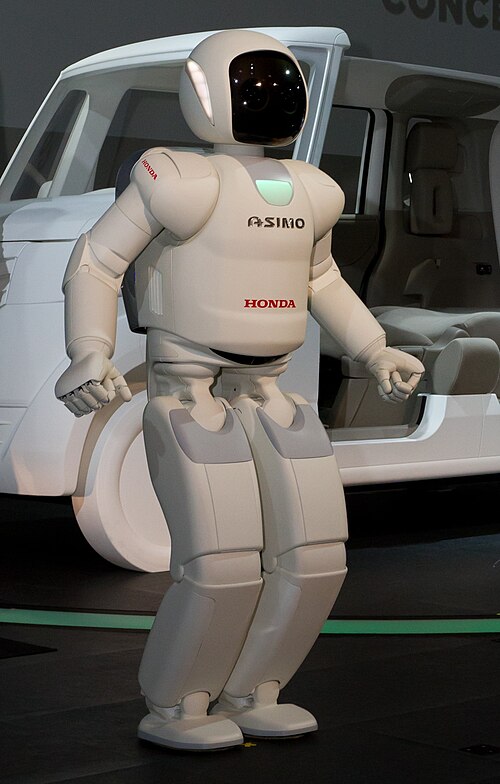
HumanoidNew ASIMO with autonomous behaviour
On 8 November 2011, Honda introduced an all-new ASIMO with autonomous behaviour control technology, which it described as a world first. The robot could keep working without a human operator and make its own decisions based on its surroundings and the people around it.
Morio · CC BY-SA 3.0 · source
2011
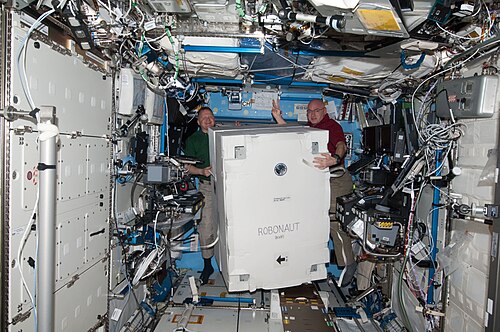
HumanoidRobonaut 2 flies to space
On 24 February 2011, NASA carried Robonaut 2 to the International Space Station on the Space Shuttle Discovery (mission STS-133). It became the first humanoid robot in space and was to test working alongside astronauts.
NASA · Public domain · source
2013
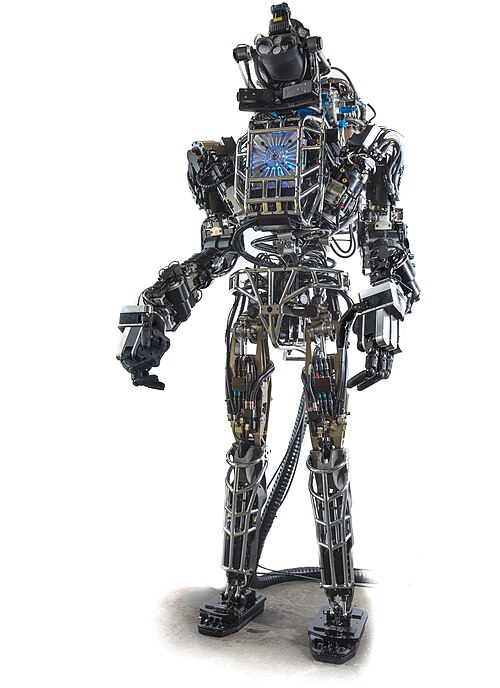
HumanoidAtlas for the DARPA challenge
Boston Dynamics supplied the Atlas humanoid for the DARPA Robotics Challenge. The platform allowed teams to develop control for tasks inspired by disaster response.
DARPA · Public domain · source
2013
HumanoidNASA's Valkyrie in the DARPA competition
In December 2013, Valkyrie, NASA's first bipedal humanoid, took part in the DARPA Robotics Challenge trials. Johnson Space Center and its partners developed the electric robot for work in damaged environments and research into future space missions.
2014
HumanoidIntroduction of the Pepper robot
On 5 June 2014, SoftBank Mobile and the French company Aldebaran Robotics introduced the humanoid robot Pepper, which, according to its makers, was to recognise human emotions. It was one of the first humanoids intended for ordinary people and shops.
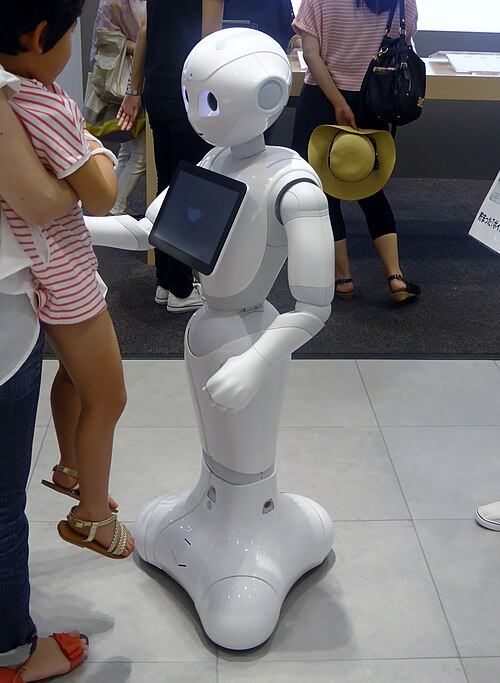
Tokumeigakarinoaoshima · CC0 · source
2015
HumanoidDRC-Hubo wins the DARPA challenge
On 5–6 June 2015 in Pomona, the KAIST team from South Korea won the finals of the DARPA Robotics Challenge with the humanoid DRC-Hubo. The robot completed all eight rescue tasks in 44 minutes 28 seconds and won the top prize of 2 million dollars.
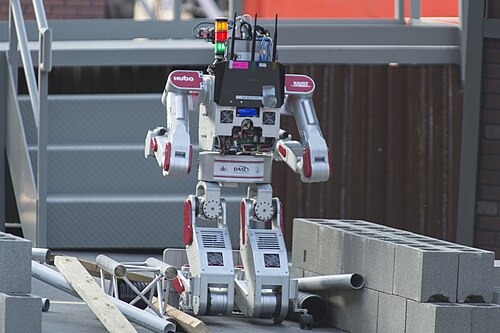
Master Chief Petty Officer John Williams · Public domain · source
2015
HumanoidPepper goes on sale
On 20 June 2015, sales of the Pepper robot began in Japan at a base price of 198,000 yen. According to SoftBank, the first 1,000 units sold out in one minute, which showed public interest in home humanoids.
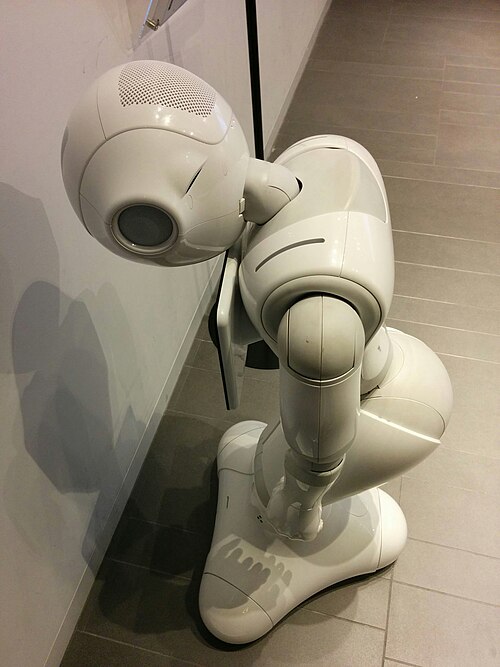
Hanonimas · CC BY-SA 3.0 · source
2017
HumanoidAtlas performs a backflip
A published demonstration of the Atlas robot showed jumps between platforms and a backflip. It demonstrated whole-body coordination during dynamic movement and landing.
2019
HumanoidIntroduction of the Digit robot
On 19 February 2019, Agility Robotics introduced the bipedal robot Digit, which extended the earlier Cassie design with a torso, arms and sensors. It could carry boxes of up to 18 kg, and in May 2019 a collaboration with Ford began on delivering parcels right to the door.
Commercial wave (since 2020)
2020
HumanoidDigit offered commercially
In January 2020, Agility Robotics began selling Digit to commercial customers at a price “in the low to mid six figures” in dollars. The first customer was Ford, with two robots; The Robot Report called it the first commercially sold humanoid with both walking and manipulation.
2021
HumanoidThe Ameca humanoid
At the beginning of December 2021, the British company Engineered Arts from Cornwall introduced the humanoid Ameca with very expressive facial expressions. Its video had over 10 million views, and the robot made its first public appearance at CES 2022.
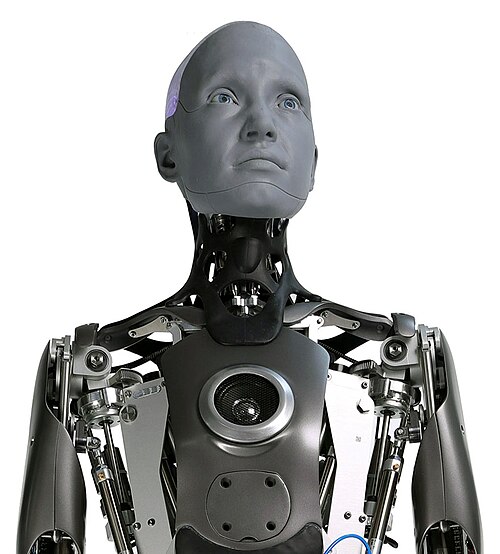
Willy Jackson · CC BY-SA 4.0 · source
2023
HumanoidFigure 01's first steps
On 17 October 2023, the American company Figure publicly showed the humanoid Figure 01 walking dynamically on two legs for the first time. It developed the robot, which has 41 degrees of freedom, in just over 12 months, which the company called one of the fastest humanoid developments.
2023
HumanoidUnitree presents H1
On 15 August 2023, the Chinese company Unitree, known for its four-legged robots, introduced its first general-purpose humanoid, H1 (about 1.8 m and 47 kg). The announced price of under 90,000 dollars was remarkably low for a full-size humanoid.
2024
HumanoidAtlas switches to electric drive
Boston Dynamics introduced a fully electric generation of the Atlas humanoid. The new platform began the next stage of development towards industrial use.
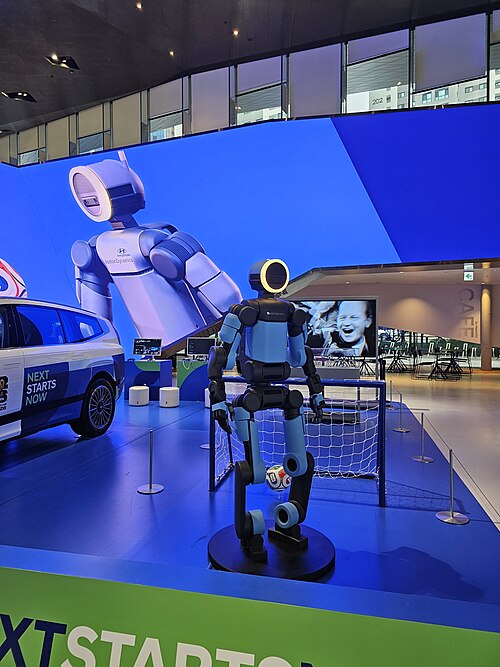
Damian B Oh · CC BY-SA 4.0 · source
2024
HumanoidCommercial agreement to deploy Digit
On 27 June 2024, GXO Logistics and Agility Robotics announced a multi-year agreement to deploy Digit robots as a rental (Robots-as-a-Service) in a warehouse for the SPANX brand. The companies called it the first formal commercial deployment of humanoid robots.
2024
HumanoidThe NEO Beta prototype
On 30 August 2024, the company 1X introduced NEO Beta, a prototype bipedal humanoid intended for homes, with a soft covering and an emphasis on safety. Later in 2024, it planned to deploy a limited number of units in selected homes for research.
2024
HumanoidIntroduction of Figure 02
On 6 August 2024, Figure introduced the second generation of its humanoid, Figure 02, completely redesigned, with speech communication through models developed with OpenAI, six cameras and hands with 16 degrees of freedom. The robot had previously been tested at the BMW plant in Spartanburg.
2024
HumanoidUnitree presents G1
In May 2024, at the ICRA conference, Unitree introduced the smaller humanoid G1 (about 127 cm) with a base price of 16,000 dollars. It was among the cheapest humanoids on the market and was aimed mainly at research laboratories.
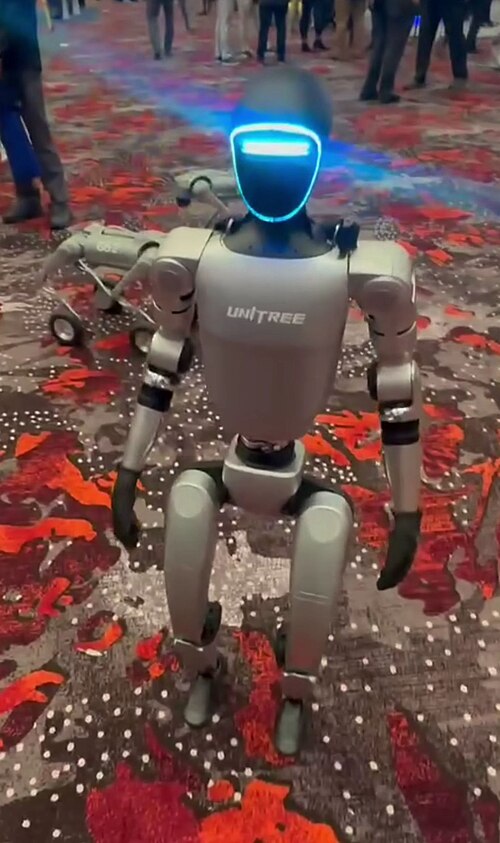
Sayanesy · CC0 · source
2025
HumanoidAgiBot A2 walked a record 106 kilometres
The AgiBot A2 humanoid completed a 106.286 km walk in China. Guinness World Records recorded the feat as the longest journey walked by a humanoid robot. It was an endurance test in a real outdoor environment.
2025
HumanoidFigure 02 ends its 11-month deployment at BMW
In November 2025, Figure published the results of the 11-month deployment of Figure 02 robots at the BMW Spartanburg plant: over 1,250 hours of operation, over 90,000 sheet-metal parts loaded and a contribution to the production of over 30,000 X3 cars. It is among the first documented operations of a humanoid on a running production line.
2025
HumanoidFigure raises over 1 billion USD at a valuation of 39 billion
On 16 September 2025, the American company Figure AI announced a Series C funding round with more than 1 billion USD in committed capital at a post-money valuation of 39 billion USD. The round was led by Parkway Venture Capital, with participation from Brookfield, NVIDIA and Intel Capital, among others.
2025
HumanoidThe NEO humanoid goes on pre-sale for households
On 28 October 2025, the company 1X launched pre-sales of the NEO home humanoid for 20,000 USD or a subscription of 499 USD per month, with deliveries to homes in the USA from 2026. It was one of the first offers of a humanoid directly to consumers; more complex tasks are initially controlled by a remote operator.
2025
HumanoidThe first half marathon for humanoid robots in Beijing
On 19 April 2025, the first half marathon in which humanoid robots ran alongside people was held in Beijing's E-Town (Yizhuang) district. It was won by Tiangong Ultra from the Beijing Humanoid Robot Innovation Center in 2:40:42, and only 6 of the 20 teams completed the 21.0975 km course.
2025
HumanoidThe first World Humanoid Robot Games
In August 2025, Beijing hosted the first World Humanoid Robot Games, the first comprehensive sporting event in which humanoid robots competed. 280 teams from 16 countries competed in 26 events, from running and football to sorting medicines and cleaning.
2025
HumanoidIntroduction of NEO Gamma
The company 1X introduced the humanoid NEO Gamma, aimed at home environments. The new generation was meant for further development and internal home testing.
2026
HumanoidAgiBot produces its 10,000th humanoid
On 30 March 2026, the Shanghai company AgiBot announced that it had produced its 10,000th humanoid robot. It went from 5,000 to 10,000 units in about three months, whereas the first 1,000 units took almost two years – a sign of humanoids moving to mass production.
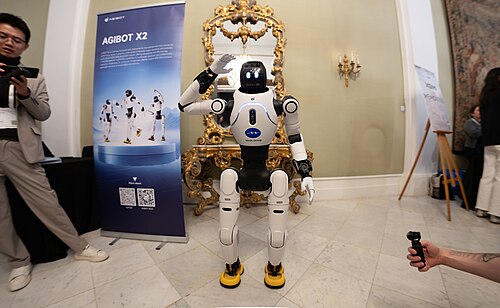
JJxFile · CC BY 4.0 · source
2026
RoboticsAgiBot begins deploying robots at Chimelong park
AgiBot and Chimelong launched the first phase of robot deployment at Chimelong Spaceship park in Zhuhai, China, on 24 September 2026. According to the manufacturer, it includes over 300 robots for entertainment, education, visitor navigation and hotel services. Industry publication blooloop also reported on the deployment.
2026
HumanoidAtlas hands over the ball at the football World Cup
On 5 July 2026, Atlas handed the ball to the referee at half-time of the Brazil–Norway round-of-sixteen match at New York New Jersey Stadium. According to Boston Dynamics, the demonstration required the humanoid to move on grass in a noisy environment in front of spectators.
2026
HumanoidFigure 03 demonstrates logistics work at BMW
In June 2026, Figure demonstrated the Figure 03 humanoid performing a logistics task at BMW's Spartanburg plant. According to the manufacturer, the robot picked and sequenced parts and moved a trolley, with Helix 02 control combining manipulation with whole-body movement.
2026
HumanoidFigure published a home experiment with Helix 2.5
Figure introduced Helix 2.5 and published an experiment in 30 previously unseen homes. According to the company, the model completed 56 % of attempts at tidying toys, folding towels and making beds. It learned the tasks elsewhere and received no further training in the test homes. This is a manufacturer demonstration.
2026
HumanoidIRON leaves XPeng's new production line
In September 2026, XPeng announced the commissioning of a production line for the IRON humanoid in China. According to the manufacturer, the completed robot walked off the line autonomously. The company described the event as a transition from prototype development to production on a line.
2026
HumanoidOpening of the Atlas training centre at Hyundai
In September 2026, Boston Dynamics opened the RMAC centre at the Hyundai Motor Group Metaplant America site near Savannah. According to the company, Atlas robots learn logistics tasks and automotive part sequencing there in a real environment. The centre serves training and validation ahead of wider deployment.
2026
HumanoidThe production Atlas and the start of manufacturing
On 5 January 2026, Boston Dynamics unveiled the production version of the electric Atlas humanoid at CES and immediately began manufacturing it. All units for 2026 went to Hyundai's RMAC centre and to Google DeepMind; further customers are to follow in 2027.
Damian B Oh · CC BY-SA 4.0 · source
2026
HumanoidChina's first national standards for humanoids
In October 2026, China published its first six national standards for humanoid robots: five parts on technical requirements (general, environmental perception, decision-making, motion control, manipulation) and a standard for simulation testing. They are to take effect from 1 April 2027.
2026
HumanoidRobot beats the human half-marathon record
On 19 April 2026, the humanoid Lightning (Flash) from Honor ran the Beijing half marathon in 50:26 with autonomous navigation, faster than Jacob Kiplimo's human world record of 57:20. A year earlier, the winner had needed 2:40:42; over 100 teams started.
2026
HumanoidTesla announces that Optimus production has begun in Fremont
In October 2026, Tesla announced that it had begun producing the Optimus humanoid robot in Fremont. In its earnings report, it described California production as an initial ramp-up.
2026
HumanoidUBTECH launches automated production in Liuzhou
In September 2026, UBTECH's production base in Liuzhou, China, began operations. Robotic systems also participate in assembly and logistics. Sources report a planned annual capacity of approximately 10 000 robots.
2026
HumanoidUnitree lists on the Shanghai stock exchange
On 19 August 2026, the humanoid maker Unitree listed on Shanghai's STAR Market and raised about 6.1 billion yuan in its IPO; on the first day, its shares closed more than 460% higher. According to the prospectus, Unitree delivered over 5,500 humanoids in 2025.
Sayanesy · CC0 · source